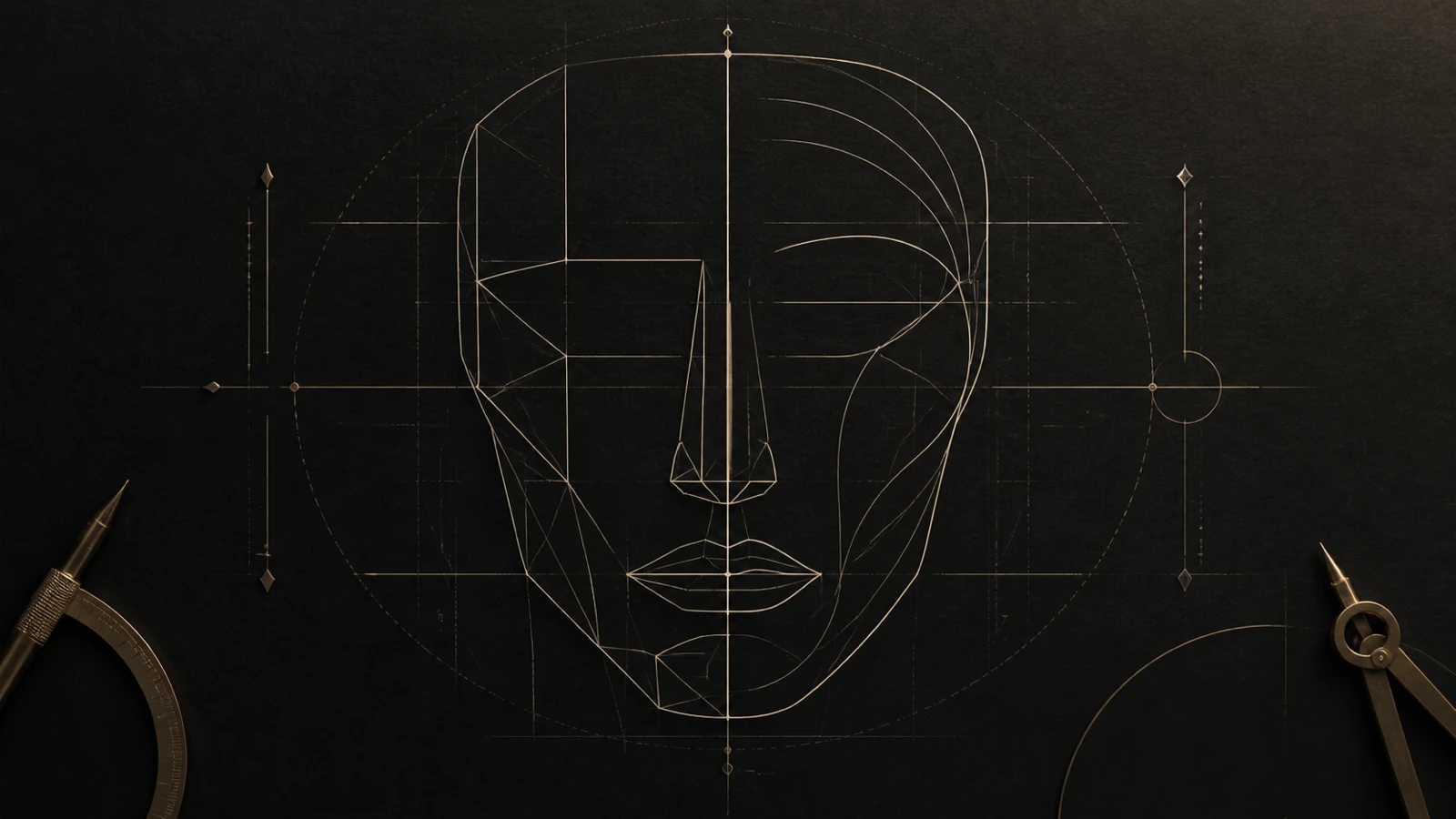
When we describe a face as "striking and defined" or "softly contoured," what anatomical traits are we actually observing? In biology and evolutionary psychology, these distinct variations in facial bone structure and soft tissue—driven primarily by sex hormones—are known as sexual dimorphism.
For decades, both mainstream beauty culture and traditional aesthetic surgery have harbored a common misconception: that feminine faces must conform to an ultranarrow set of delicate proportions, while masculine faces must feature an intensely square jawline. However, academic research has long demonstrated that human facial aesthetics and balance are far richer than simple binary stereotypes. Modern computational aesthetics and AI algorithms are re-examining dimorphic feature variations to establish more inclusive, realistic facial ratio benchmarks.
Sexual Dimorphism in Evolutionary Biology: Signals in Bone and Soft Tissue
The development of dimorphic facial traits is heavily influenced by developmental hormone levels, particularly androgens like testosterone and estrogens. These hormones leave distinct imprints on facial bone structure and soft tissue:
- Mandibular structure and lower-face width: Elevated testosterone typically promotes lateral growth of the mandible and vertical extension of the chin, creating a wider, more defined lower facial contour. When estrogen dominates, mandibular angles are generally softer, with a more tapered chin.
- Supraorbital ridge and orbital contours: Masculine faces often exhibit a more prominent brow ridge and thicker superior orbital rims, yielding deeper-set eyes. Feminine brow ridges tend to be smoother, with rounded orbital rims.
- Facial proportions and soft-tissue distribution: Feminine faces typically possess thicker subcutaneous fat deposits and fuller lips, resulting in smoother midface curvature and softer transitions.
According to a review by Little et al. (2011) in Philosophical Transactions of the Royal Society B, facial features function as a highly flexible signaling system in human social interaction. While sexually dimorphic traits play a key role in mate preferences, the authors emphasize that individual attraction to "hyper-masculine" or "hyper-feminine" traits is far from fixed. Instead, preferences fluctuate dynamically based on environmental context, social cognition, and individual variance. Consequently, no single extreme dimorphic metric defines universal perfection.
Proportions and Balance: Why One Standard Cannot Fit All Faces
Applying average feminine proportions directly to masculine faces—or evaluating all faces against a rigid square-jaw benchmark—inevitably skews aesthetic assessment.
A study by the neuroaesthetics research team at the University of Pennsylvania (Villavisanis et al., 2022) explored the relationships between facial proportionality, attractiveness, and perceived character traits. The researchers emphasized that overall proportional harmony matters far more than the exaggeration of any isolated feature. In short, the synergistic relationship (harmony) between features is significantly more important than absolute dimensional values.
For instance, a woman with a broader jawline paired with wider intercanthal distance and a structured nasal bridge often projects a striking, harmonious, modern elegance. Conversely, narrowing the jaw simply to chase a generalized "V-shape" can destabilize structural support across the mid- and lower face.
When discussing facial ratios, the golden ratio (φ ≈ 1.618) is frequently mentioned. In empirical research, however, the golden ratio serves merely as one exploratory reference line among many, rather than an absolute rule of facial beauty. For a deeper dive into these metrics, explore our article on The Science of Facial Harmony.
How Algorithms Stay Neutral: Stereotype-Free Proportional Measurement
Traditional manual evaluations frequently introduce subjective bias and can easily degenerate into anxiety-inducing scoring systems. By contrast, modern computational facial analysis decouples measurement from rigid stereotypes to focus purely on internal geometric relationships.
In their anthropometric research on facial beauty and proportions, Milutinovic et al. (2014) demonstrated through objective geometric measurements that facial balance stems from internal alignment across classical divisions (such as the facial thirds and fifths), rather than conforming to a single rigid template.
When processing sexually dimorphic features, modern AI analysis operates on several neutral principles:
- Multi-Benchmark Alignment: Dynamically aligns reference benchmarks based on objective skeletal and contour geometry, avoiding the imposition of a one-size-fits-all gender template.
- Ratios over Raw Values: Prioritizes structural relationships—such as forehead plane ratio and the alignment between midface height and jaw width—rather than labeling individual features as "too wide" or "too narrow."
- No Public Shaming or Arbitrary Ratings: Scientific analysis avoids subjective beauty scores and public leaderboards, providing objective structural insights that foster a balanced understanding of facial features.
Exploring Your Own Proportional Balance
Understanding facial dimorphism and proportional balance is never about conforming to an arbitrary ideal or seeking surgical intervention (this article is strictly educational and does not constitute medical advice or surgical planning). Rather, it helps you recognize your natural skeletal strengths so you can find your optimal visual balance in daily styling, hair design, or photography.
If you want an objective, private look at your facial geometry, consider trying FacialHarmonyAI.
- Browser-based local analysis: Simply upload a single frontal photo. Facial landmark detection runs entirely in your local browser—your photo is never uploaded to external servers, protecting your privacy.
- Multidimensional ratio assessment: The system extracts roughly 30 facial and forehead plane ratio metrics to assess natural balance and dimorphic tendencies without judgmental language or subjective scoring.
- Free preview & transparent pricing: Enjoy a free preview of landmark points and basic ratios. For comprehensive insights, access the complete Atelier report with a one-time $9.99 purchase (no subscription or hidden fees). You can also explore our sample report to see the exact geometric dimensions measured.
Every face reflects unique evolutionary traces and geometric rhythm. By understanding how sexual dimorphism influences facial structure, we can foster a healthier, more grounded perspective on personal aesthetics.
References
- Little, A. C., Jones, B. C., & DeBruine, L. M. (2011). Facial attractiveness: evolutionary based research. Philosophical Transactions of the Royal Society B: Biological Sciences, 366(1571), 1638-1659. PMC3130383
- Villavisanis, D. F., et al. (2022). Associations of Facial Proportionality, Attractiveness, and Character Traits. University of Pennsylvania Neuroaesthetics Publication. PDF Link
- Milutinovic, J., Zelic, K., & Nedeljkovic, N. (2014). Evaluation of facial beauty using anthropometric proportions. The Scientific World Journal, 2014. PMC3951104