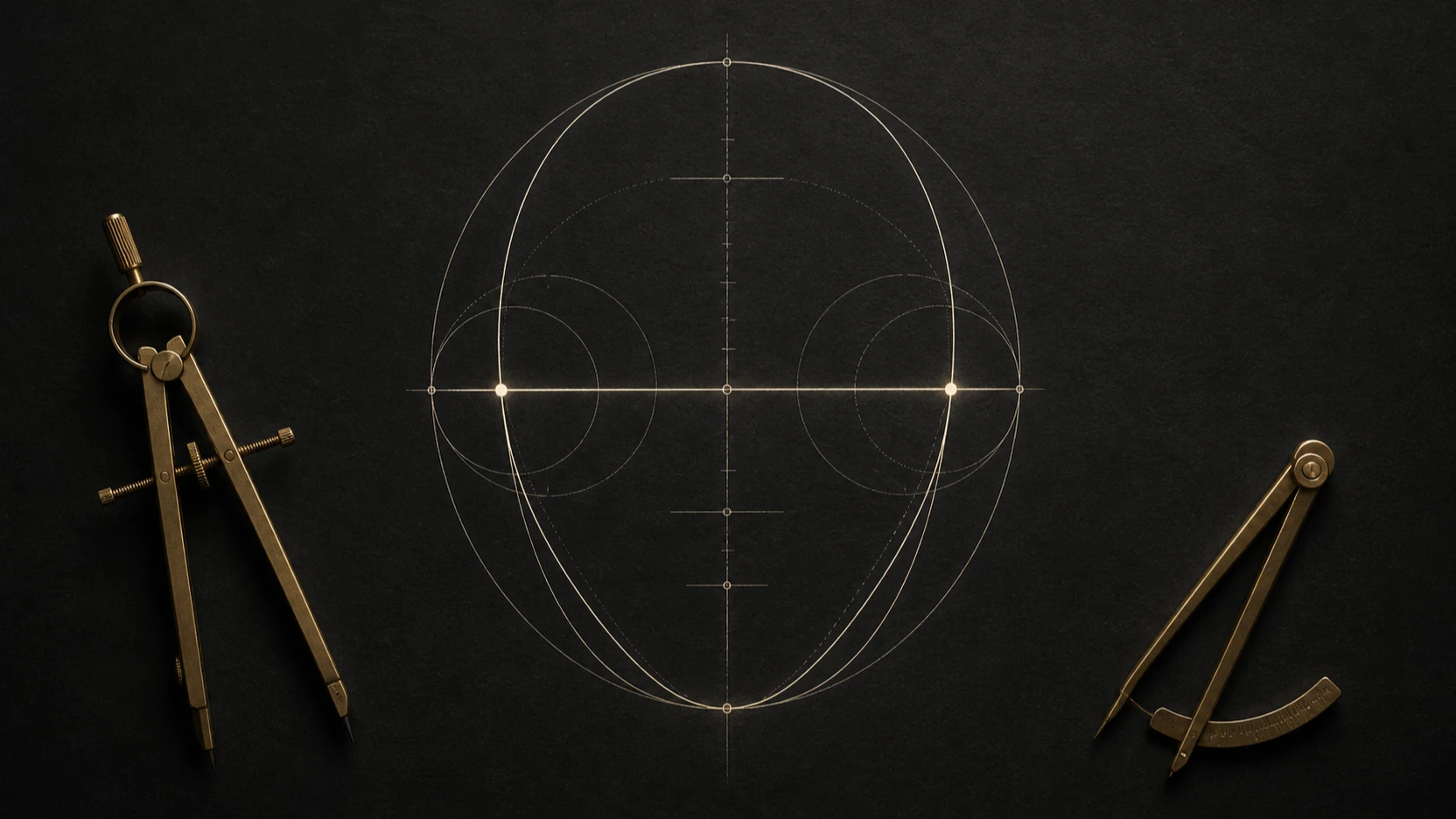
Many people reviewing selfies or looking in the mirror feel their cheekbones appear disproportionately wide or overly prominent. In anthropometry, however, facial morphology is never a simple sum of isolated bone dimensions. Visual structure depends on relative proportions across several key horizontal widths.
The perceived prominence of your cheekbones is largely defined by the transition between bizygomatic breadth (cheekbone width), bitemporal width (upper temples), and bigonial breadth (lower jaw angles). Understanding how these three horizontal tiers interact helps you evaluate your facial contours objectively rather than fixating on a single dimension.
Why absolute width alone does not tell the whole story
In classical craniofacial morphology, the most lateral bony landmark on the zygomatic arch is called the zygion (zy). The horizontal distance between the two zygion points is the bizygomatic breadth (zy-zy). In the vast majority of adult populations, bizygomatic breadth represents the widest horizontal dimension of the front face.
Even when two individuals share the exact same bizygomatic breadth in millimeters, their visual balance can look entirely different:
- Full temples and moderate jaw taper: Bizygomatic width flows smoothly into upper and lower contours, creating an oval or soft square silhouette.
- Narrow temples or a sharply tapered jaw: The zygomatic arches protrude outward more visibly, creating sharper skeletal angularity.
- Bigonial jaw width close to bizygomatic width: The facial outline appears rectangular or trapezoidal, which actually softens the relative projection of the cheekbones.
In morphological research by Milutinovic et al., 2014, measurements confirmed that visual harmony stems from balanced proportional ratios across facial zones rather than the absolute size of any isolated feature.
Preparing a standardized front photo
Before calculating width ratios, camera parameters determine whether your measurements are meaningful. Close-up selfies taken with a wide-angle front camera introduce severe perspective distortion, exaggerating the nose, widening the midface, and compressing the temples and jawline.
Follow these guidelines when capturing your test image:
- Distance and focal length: Place your rear camera 1.5 to 2 meters away, using a 2x or 3x telephoto setting (equivalent to a 50mm to 85mm lens), or have someone photograph you at eye level.
- Natural head position (NHP): Look straight at the lens without tilting up or down. Tilting up compresses the midface and widens the jawline, while tilting down exaggerates forehead width.
- Clear bone contours: Comb bangs and side hair behind your ears so your temple hollows, zygomatic arches, and jaw angles are fully visible.
- Neutral expression: Relax your facial muscles. Keep your teeth resting lightly together without clenching your masseter muscles, and keep your lips naturally closed.
If you have already evaluated your vertical profile, you can cross-reference your results with our guide on measuring facial thirds for full horizontal and vertical context.
Identifying key landmarks and three facial widths
On a standardized digital portrait, relative ratios can be calculated directly using pixel coordinates. As long as all measurements come from the same undistorted photo, pixel ratios are mathematically identical to real physical proportions.
          ft •-----------------------• ft      (Bitemporal Width)
                 \               /
        zy •------\-------------/------• zy    (Bizygomatic Breadth)
                     \       /
            go •------\-----/------• go        (Bigonial Breadth)
                       \   /
                         • gn                  (Gnathion)
1. frontotemporale and bitemporal width (ft-ft)
- Landmark location: Frontotemporale (ft) is the soft-tissue point over the deepest indentation of each temporal line on the frontal bone, marking the narrowest transition between the hairline and the temples.
- Measurement: Horizontal pixel distance between the left and right ft points.
2. zygion and bizygomatic breadth (zy-zy)
- Landmark location: Zygion (zy) is the most lateral point on the contour of each zygomatic arch.
- Measurement: Horizontal pixel distance between the left and right zy points, serving as the baseline for midface width.
3. gonion and bigonial breadth (go-go)
- Landmark location: Gonion (go) is the most lateral soft-tissue point corresponding to the angle of the mandible where the ramus meets the mandibular body.
- Measurement: Horizontal pixel distance between the left and right go points.
Core facial width ratio calculations and reference values
Once your three horizontal pixel widths are measured, apply the following formulas to evaluate your midface balance:
$$\text{Upper-to-Midface Width Ratio} = \frac{\text{Bitemporal Width (ft-ft)}}{\text{Bizygomatic Breadth (zy-zy)}} \times 100%$$
- Reference range: In classical anthropometric datasets (such as Farkas et al., 1994), bitemporal width in healthy adults typically falls between 75% and 85% of bizygomatic breadth.
- Visual impact: Ratios below 75% highlight zygomatic arch angularity due to narrower temples. Ratios above 85% create a softer, more rounded upper contour.
$$\text{Mid-to-Lower Face Width Ratio} = \frac{\text{Bigonial Breadth (go-go)}}{\text{Bizygomatic Breadth (zy-zy)}} \times 100%$$
- Reference range: Morphological reviews (detailed in the QOVES facial proportionality guide) show adult female ratios commonly fall between 70% and 78%, while adult male ratios typically range from 75% to 85% due to mandibular development.
- Visual impact: Lower ratios create a tapered, heart-shaped silhouette. Higher ratios provide clear mandibular definition with structured, square geometry.
| Measurement metric |
Formula |
Typical population range |
Contour presentation |
| Upper-to-midface ratio |
Bitemporal / Bizygomatic |
75% to 85% |
Lower values accentuate cheekbones; higher values show fuller temples |
| Mid-to-lower ratio |
Bigonial / Bizygomatic |
70% to 82% |
Lower values taper inward; higher values display defined jaw structure |
| Facial index (width-to-height) |
Bizygomatic / Total face height (n-gn) |
70% to 80% |
Identifies overall face shape as slender, balanced, or broad |
Common misconceptions in facial width evaluation
When evaluating your own contours, keep these frequent points of confusion in mind:
- Mistaking hair volume for true bone width: Voluminous sideburns or parted hair can drastically change perceived temple width. Accurate calculation requires identifying the actual cranial boundary. For everyday styling, adjusting root volume at the temples is an accessible way to modify your perceived upper-to-midface ratio.
- Equating soft tissue with skeletal flare: Subcutaneous cheek fat, the buccal fat pad, and masseter muscle thickness directly influence how prominent the cheekbones appear. Leaner cheek and temple tissues can make average-width cheekbones look significantly sharper.
- Treating the golden ratio as a rigid standard: While the golden ratio ($\phi \approx 1.618$) appears frequently in aesthetic literature, modern anthropometry embraces anatomical diversity across sexes and ethnic groups. Proportional measurements exist to map your natural geometry objectively, not to rank your features.
Manually placing landmarks on photos offers good intuition, but slight pixel placement errors can shift calculated ratios. If you want a consistent geometric overview, you can test our online facial proportion test.
FacialHarmonyAI uses privacy-first, in-browser algorithms. All MediaPipe landmark detection and ratio calculations run locally on your device without uploading original photos to external servers. The tool provides a free preview covering basic spatial proportions across 30+ ratios. For comprehensive symmetry, vertical thirds, and horizontal balance analysis, you can unlock the complete Atelier report with a $9.99 one-time purchase (no subscription).
Disclaimer: The anthropometric ratios and tools described in this guide are intended solely for personal styling, photography, and geometric appreciation. They do not constitute medical diagnosis, surgical planning, or clinical advice.
References
- Milutinovic, J., Zelic, K., & Nedeljkovic, N. (2014). Evaluation of facial beauty using anthropometric proportions. The Scientific World Journal, 2014, 428250. PMC3951104
- Farkas, L. G., et al. (1994). Craniofacial norms in North American Caucasians from birth to young adulthood. PubMed. PMID: 8078553
- QOVES Research. Facial Proportionality: An Evidence-Based Guide. QOVES Insights