Last month I was sitting in a salon chair, clutching six heavily edited photos of French wavy bobs on my phone. The stylist was running a fine tooth comb through my crown, pushing hard for a root perm and curtain bangs. My heart was racing next to the shampoo sink, and I came within seconds of pulling out my phone to pay hundreds of dollars for a perm package before I had even checked my midface length against my overall facial outline. Fortunately, the water came out scalding hot, which jolted me awake for a few seconds. I made up an excuse about being late and ran out. When I got home and measured carefully in front of a full-length mirror, I realized my cranial crown was already quite tall and my midface ran slightly long. Adding extra volume on top would have only stretched my entire face vertically into a narrower, longer look.
The moment appearance anxiety hits, it is easy to treat someone else's makeover plan as your immediate lifesaver. You might have stumbled across a beauty influencer's glow up video late at night, or spotted an elevator ad showing before and after profile changes from orthodontic work, instantly feeling a rush to overhaul your entire look. Before you swipe your card, book an expensive consultation, or chop off hair you spent three years growing, what you need most is not another roundup of tips. You need an objective facial proportion baseline.
What you should actually do in the first ten minutes of a makeover impulse
When the sudden urge to fix your face takes over, the first ten minutes are the danger zone where emotions hijack your judgment. Most people make three immediate mistakes during this window: opening shopping apps to search for trending contour palettes or hair extensions, scrolling through dramatic success stories on social media, or staring into a harsh bathroom mirror under direct overhead lighting to hunt for flaws.
None of these three actions solve anything. They only magnify local insecurities. Downward overhead lighting deepens the shadows under your eyes and along your nasolabial folds. Wide angle front facing phone cameras distort your nose into looking far larger than it is, and recommendation algorithms feed you extreme, non-standard templates.
In those critical first ten minutes, the single best move is to hit pause and create physical distance.
Step away from that unflattering mirror and close your social apps. Walk over to a window with plenty of soft, indirect natural light. Mount your phone level with your eyes, step back about five to six feet, and use the rear camera to take an unsmiling, straight-on photo at eye level. Do not smile, do not tilt your head down, and do not look at the lens from an angle.
This photo is not for social media, and it is not for nitpicking flaws. It is your raw, undistorted baseline reference material. Without this baseline, every styling idea you build rests on shifting sand. Once you capture your true geometric proportions, the urgency fueled by the impulse will fade.
Why stylists, aesthetic consultants, and beauty influencers often give you the wrong advice
When you ask the outside world for advice with only a vague idea of what you want to change, you quickly discover that everyone gives conflicting answers. This rarely comes from bad intentions. It happens because every advisor has their own commercial incentives and cognitive blind spots.
Hairstylists often rely on localized compensatory thinking. In beauty school training, the standard rule of thumb is usually to add volume wherever there is a hollow and cover wherever the face looks wide. If you feel your face looks broad, a stylist's reflex is often to cut thick framing layers to hide your cheeks. But if your jaw angle is already well defined and your chin is simply on the shorter side, draping heavy hair over your cheeks draws all visual focus directly to your lower face, making your chin look even more compressed. A stylist evaluates the bounce of your hair, but often overlooks how it interacts with the vertical proportions of your features.
Clinic consultants are shaped by isolated quantification and sales targets. During consultations, they tend to isolate one specific feature to highlight, suggesting you extend your chin forward by a few millimeters or raise your nasal bridge slightly. This single-point advice sounds concrete and actionable, but perceived facial aesthetics come from the balance between features rather than isolated measurements. Lengthening a chin on an otherwise soft, flatter facial profile immediately throws off the balance between your lips and chin.
As for beauty influencers on social platforms, their tips are tailored to their specific bone structure and studio lighting setups. A contouring technique designed by a creator with sharp cheekbones and deep facial depth will usually turn into two muddy streaks on a flatter, softer face.
These professionals are skilled at noticing subtle regional changes, often far better than the average person. But their recommendations are frequently fragmented, missing a comprehensive look at the geometric baseline of your entire face.
Why posting selfies in group chats or forums for ratings only makes you more anxious
Beyond asking professionals, many people post selfies to friend groups or public forums asking for feedback. This usually triggers a whole new layer of stress.
Consider a common situation: a college senior named Sarah is getting ready for fall campus recruiting and wants a polished professional headshot. To figure out what makeup style and hair suited her best, she snapped two front-camera selfies in her dorm room and posted them to a peer group chat with hundreds of members, asking what her biggest facial flaw was and how she should fix it.
Within thirty minutes, dozens of replies rolled in. One person said her chin was recessed and suggested braces. Another said her eyes were set too far apart and recommended inner corner surgery. A third claimed her nasal bridge was too flat and needed heavy contouring. Sarah spent the whole night staring in the mirror analyzing those fragmented comments, and the next morning she could barely look people in the eye.
Sarah ran straight into observer bias and display inconsistency. Everyone views photos at different screen brightness levels, carries distinct aesthetic preferences, and is swayed by whatever mood they are in that day. More importantly, selfies taken with a standard front lens from twelve inches away produce noticeable perspective distortion, artificially expanding the nose in the center while flattening the cheekbones at the edges. That image was never an accurate representation of her to begin with.
In evolutionary psychology and cognitive science, empirical research demonstrates how complex human face perception really is. In their review of evolutionary mechanisms behind facial attractiveness, researchers Little et al., 2011 noted that visual perception of faces is shaped not only by biological markers, but also by an observer's visual experience, recently seen faces, and social learning within groups. Quick ratings from online strangers offer no stable reference value. They are simply personal biases projected onto a distorted picture.
Relying blindly on subjective ratings is as unreliable as asking ten random pedestrians to guess which wall in a building is load-bearing.
Where can you actually verify objective facts amidst conflicting aesthetic claims?
If subjective advice and internet rating scales cannot be trusted, where should you turn for dependable guidance before spending money on your appearance?
The answer lies in peer-reviewed empirical research and measurement baselines built on objective coordinates.
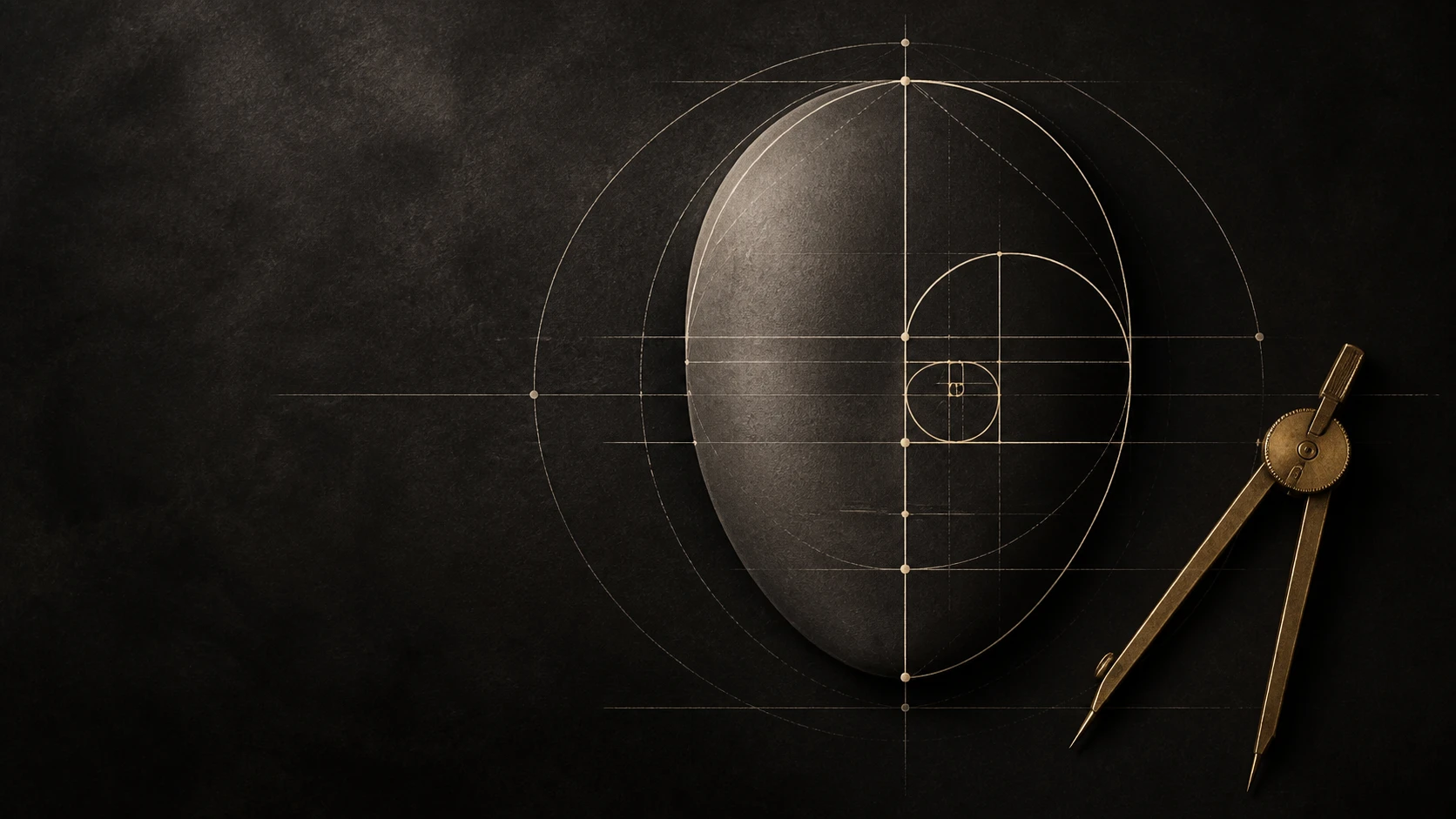
Aesthetics is neither pure mystery nor a rigid formula pushed by marketing campaigns. Take the widely cited golden ratio (1:1.618) as an example. Many beauty accounts overlay a golden mask on every face, claiming anything outside this ratio is flawed. However, a systematic review published in a leading dental journal by Londono et al., 2024 analyzed extensive facial measurement datasets and found that diverse, naturally attractive faces across populations do not strictly follow the golden ratio across vertical heights and regional intervals. The golden ratio serves as a geometric concept in classical art, but there is no single universal ratio governing real human anatomy.
Another common source of unnecessary worry is facial asymmetry. Many people flip a selfie, notice that one eyebrow sits higher or their mouth rests slightly unevenly, and immediately panic. Yet a prospective clinical study in personalized medicine by Eißing et al., 2024 clearly showed that the human visual system has a forgiving threshold for mild facial asymmetry. Slight differences between left and right sides do not disrupt overall visual harmony at standard conversational distances; only significant asymmetry crossing a distinct threshold is perceived as imbalance. Years earlier, classic work by experimental psychologist Rhodes et al., 1998 demonstrated that while perfectly mirrored synthetic faces look orderly, they are not the sole standard of attractiveness in everyday life. Subtle natural asymmetry is a standard biological trait.
When evaluating aesthetic ideas, keep two core principles in mind:
- Focus on relative proportions rather than arbitrary scores: Any tool that assigns your face an arbitrary 6.5 or 7.2 out of 10 uses a black box algorithm designed to manufacture superiority or insecurity. What actually helps is knowing the exact percentage of your vertical face occupied by your midface, or how your intercanthal distance compares to your nasal base width.
- Know the tool scope and respect clinical boundaries: Everyday proportion analysis is meant for personal styling and aesthetic evaluation, never as a substitute for an in-person clinical consultation with an oral surgeon, orthodontist, or dermatologist. Objective geometric data helps you avoid mistakes with haircuts, makeup, and styling. It is not a guide for invasive medical procedures.
Core facial geometry reference table: understanding your visual baselines
To build an objective baseline, you do not need to memorize anatomical jargon. You only need a few core frontal geometric relationships. In landmark perceptual experiments, vision researchers Pallett et al., 2010 showed that the vertical distance from eyes to mouth and the horizontal distance between pupils relative to overall face dimensions directly influence how smoothly the brain processes a face. We can simplify these academic measurements into practical styling baselines:
| Measurement dimension |
Geometric relationship |
Common visual reference range |
Common misjudgments and wasted effort |
Low-risk adjustment strategy |
| Vertical facial thirds |
Hairline to brow / brow to subnasale / subnasale to chin |
Each segment occupies roughly 30% to 36% of vertical facial height |
Perming high root volume on an already long midface, stretching the face further |
Use light, airy bangs to soften the upper third and apply horizontal blush to break vertical length |
| Intercanthal width to face width |
Distance between inner eye corners vs widest bizygomatic width |
Intercanthal distance spans roughly 20% to 25% of total face width |
Getting inner corner surgery for wide-set eyes, losing an open, relaxed look |
Lightly shape inner brows to create gentle cohesion while preserving natural facial space |
| Vertical eye-to-mouth ratio |
Distance from interpupillary midpoint to mouth line vs face length |
Vertical distance occupies roughly 34% to 38% of total face height |
Getting lip fillers without checking the balance between philtrum and chin |
Soften the lower lip edge or define the cupid's bow to balance the visual center |
| Jaw-to-cheekbone width ratio |
Bigonial jaw width vs bizygomatic cheekbone width |
Jaw width measures roughly 70% to 80% of cheekbone width |
Assuming a defined jaw means a wide face and hiding it with heavy hair |
Keep the jawline visible and wear vertical drop earrings to highlight bone structure |
| Horizontal symmetry offset |
Difference in distance from paired landmarks to the vertical facial midline |
Offsets within 3% to 5% are within the normal natural range |
Obsessing over a 1 to 2 mm eyebrow height difference and over-plucking |
Part hair slightly off-center (like a side part) to soften subtle asymmetry naturally |
This table is not a rigid rulebook. It is your reality check reference. When someone tells you to tease your roots or narrow your jaw, check your own proportion data. You will immediately see whether that advice supports your overall harmony or creates fresh visual conflict.
Three low-cost steps to build your personal aesthetic profile
Once you have clear standards, how do you put them to work? You do not need expensive measuring equipment. Follow these three steps to build a dependable aesthetic baseline at home.
Step 1: capture a standardized baseline photo
The quality of your baseline photo determines the reliability of all your data. Follow these guidelines closely:
- Keep adequate distance: Keep your phone's rear camera at least five to six feet away from your face. Use a tripod or have a friend help. Shooting from a distance with a standard or telephoto rear lens minimizes wide-angle perspective distortion.
- Use even lighting: Face a window with diffuse natural daylight. Avoid harsh midday sun, and never shoot under bathroom spotlights or single side lamps. Even lighting ensures key facial landmarks stay free of misleading shadows.
- Maintain a neutral posture: Keep your head level (your earlobes should roughly align with the bottom of your eye sockets). Relax your expression, close your lips naturally, and tuck your hair behind your ears to keep your hairline and jawline fully visible.
Step 2: extract objective geometric coordinates and proportions
With a proper photo in hand, you need a way to map facial contours into concrete geometric points. In the past, this meant using calipers on printed paper. Modern computer vision can now map high-precision meshes in seconds.
For example, Google's open-source MediaPipe Face Landmarker framework extracts hundreds of 3D facial landmarks directly on device. The key advantage is privacy: all image processing runs locally in your phone or computer browser. Your photo is never uploaded to a remote server, eliminating facial privacy concerns.
If you want intuitive, organized data quickly, you can visit the FacialHarmonyAI homepage to use the online analysis tool. The engine calculates around thirty proportion metrics based entirely on frontal geometry, providing a free basic preview. If you want a comprehensive breakdown covering regional proportions and visual balance analysis, you can get a full one-time report for $9.99 with no recurring monthly subscriptions. The focus throughout is on mutual balance and harmony across features, rather than assigning a shaming score to your appearance.
Step 3: turn your numbers into an actionable styling checklist
Once you have your data, do not leave the report sitting in a folder. Turn it into a practical checklist. Based on your proportion baselines, write down three rules to avoid and three ideas to try:
- Note your strong balance zones: If your eye spacing relative to your face width is well balanced, keep breathing room around your eyes in your makeup rather than crowding them with heavy inner eyeliner.
- Identify your core visual focal points: If your measurements show a slightly longer midface, tell your stylist directly to avoid blunt bangs or excessive top volume. Ask for textured, breathable styling that gently draws visual attention toward the sides of your face.
- Communicate using clear data: Next time you talk to a stylist or discuss outfits, skip vague statements like feeling your face is too round. Instead, explain that your jaw-to-cheekbone ratio has strong natural bone support, and you want width around the temples to balance your outline. Replacing emotional complaints with clear facts immediately upgrades the advice you receive.
Check your baseline before spending money on major styling changes
Many people spend significant money on beauty routines, accumulating products that never work, signing up for expensive salon memberships, or jumping into trending procedures, only to find that the mirror looks less harmonious than before. The issue is rarely your natural features. It happens when you force someone else's aesthetic roadmap onto your own face without understanding your starting layout.
Real visual appeal comes from balance across features, not from assembling isolated parts according to a rigid formula. No face matches an idealized diagram, and small natural variations are what give your look its genuine character.
The next time you see an enticing makeover video late at night, or find yourself listening to high-pressure salon pitches, hold off on swiping your card or making irreversible changes.
Head home, take a proper photo, open the FacialHarmonyAI homepage, and check your facial geometry baseline. Ask yourself calmly: does this plan enhance my overall proportions, or does it disrupt my existing balance? Once the facts are clear, you will know exactly where your budget belongs, and which impulse buys to walk away from.
Frequently asked questions
Why do my facial proportions look so different between front and rear phone cameras?
This difference comes from wide-angle perspective distortion. Front-facing smartphone cameras generally have a short focal length (around 20 to 24mm equivalent). When you take a selfie from twelve inches away, features closer to the lens like your nose and chin appear noticeably larger, while your cheeks and ears recede and shrink. This distorts measured midface proportions and facial width. Always use the rear camera from at least five feet away for accurate measurements.
Do facial proportion baselines change over time?
Your underlying bone structure stays largely stable in adulthood, but soft tissue volume, skin elasticity, and hairline placement shift gradually. For example, a receding hairline increases the height of the upper third, while soft tissue descent shifts the visual center of the jawline. Rechecking your baseline every one to two years, or after a major change in body weight, helps keep your styling references current.
Should i measure again after getting braces or a major haircut?
A new haircut or orthodontic treatment changes the visual proportions of your lower face and overall silhouette. Once braces are complete, your lip profile and lower third height may shift slightly. Running a fresh baseline check helps you fine-tune your makeup and accessory choices around your updated structure.
References
- Eißing, C. H., et al. (2024). Limits in the Perception of Facial Symmetry, A Prospective Study. Journal of Personalized Medicine, 14(11), 1109. https://www.mdpi.com/2075-4426/14/11/1109
- Londono, J., et al. (2024). Assessment of the golden proportion in natural facial esthetics: A systematic review. The Journal of Prosthetic Dentistry, 131(4). https://www.thejpd.org/article/S0022-3913(22)00285-2/abstract
- Little, A. C., Jones, B. C., & DeBruine, L. M. (2011). Facial attractiveness: evolutionary based research. Philosophical Transactions of the Royal Society B: Biological Sciences, 366(1571), 1638-1659. https://pmc.ncbi.nlm.nih.gov/articles/PMC3130383/
- Pallett, P. M., Link, S., & Lee, K. (2010). New "Golden" Ratios for Facial Beauty. Vision Research, 50(2), 149-154. https://www.ncbi.nlm.nih.gov/pmc/articles/PMC2814183/
- Rhodes, G., Proffitt, F., Grady, J. M., & Sumich, A. (1998). Facial symmetry and the perception of beauty. Psychonomic Bulletin & Review, 5(4), 659-669. https://link.springer.com/article/10.3758/BF03208842
- Google AI Edge. (2024). MediaPipe Face Landmarker Guide. https://developers.google.com/edge/mediapipe/solutions/vision/face_landmarker