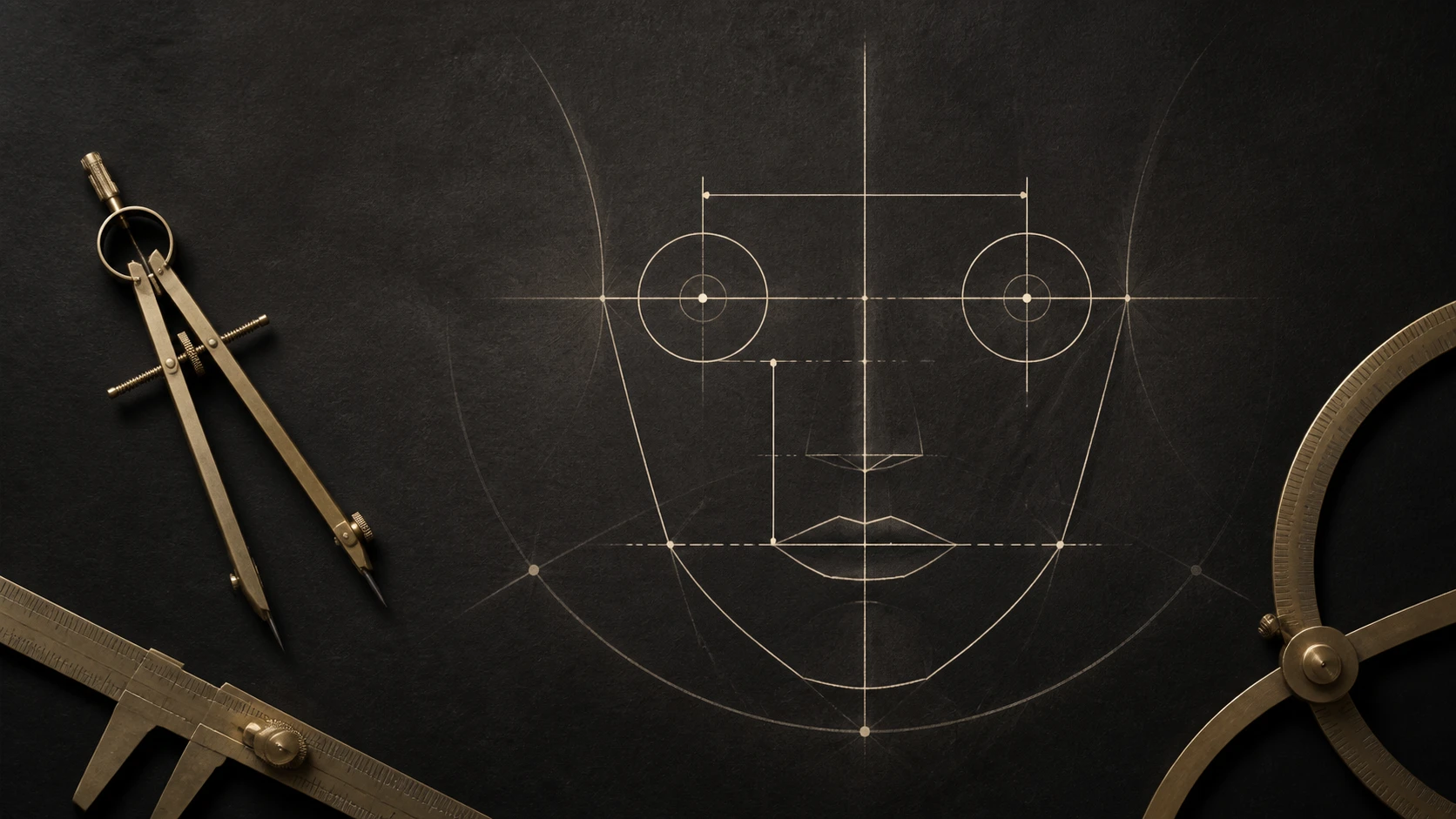
When analyzing facial proportions, a common source of confusion is feeling that your midface looks elongated or lacks compactness, even though the vertical distance from your glabella to the base of your nose falls strictly within average ranges. In reality, human visual perception does not interpret facial balance through isolated linear lengths. Instead, it processes the dynamic interplay between horizontal width and vertical spacing.
Beyond traditional facial thirds analysis, morphometric analysis often relies on the relationship between interpupillary distance (IPD) and the vertical distance from the pupil line to the upper lip. Understanding this ratio shifts the conversation away from subjective ideals toward an objective, structural view of facial harmony.
Why Vertical Facial Thirds Don't Tell the Whole Story
Traditional aesthetic models split the face vertically into thirds (forehead, midface, and lower face). However, in real-world visual perception, the midface's prominence is heavily conditioned by the horizontal frame surrounding it:
- Wider eyes or a larger IPD expand the horizontal axis of the face. This creates a visual dampening effect that makes the midface look broader and more compact.
- Narrower IPD or slim cheekbones draw visual attention straight down the vertical centerline. Even if two people have identical vertical midface lengths in millimeters, the person with narrower eye spacing will appear to have a longer midface.
To accurately evaluate midface balance, you must consider the aspect ratio rather than measuring vertical height in isolation.
How to Calculate Your Midface Ratio
In facial proportion analysis, you can use the following reference formula to evaluate your midface aspect ratio:
$$\text{Midface Compactness Ratio} = \frac{\text{Interpupillary Distance (IPD)}}{\text{Vertical Distance from Pupil Axis to Upper Lip Baseline}}$$
Step-by-Step Measurement Guide
- Identify Landmarks: On a neutral frontal photo, locate the pupil centers of both eyes and draw a horizontal line connecting them. Next, drop a perpendicular line from the midpoint of this interpupillary axis down to the highest point of the upper lip (the cupid's bow center).
- Compute the Ratio: Divide your horizontal interpupillary distance (IPD) by the vertical pupil-to-lip height.
From a direct, eye-level perspective, this ratio typically falls within a predictable range. A higher ratio indicates greater horizontal breadth relative to vertical height, yielding a softer, more youthful, or compact midface appearance. A lower ratio highlights vertical elongation, imparting a more mature or streamlined aesthetic. Importantly, this value is a structural descriptor, not a rigid prescription for attractiveness.
What Morphometric & Anthropometric Research Shows
Empirical research in experimental psychology and facial anthropometry confirms that facial harmony relies on spatial relationships rather than the standalone dimensions of any single feature.
In a seminal psychophysical study by Pallett et al. (2010), researchers manipulated feature spacing on standardized portraits. They discovered that visual perception of harmony peaked when the eye-to-mouth vertical distance was approximately 36% of total facial length, and the inter-pupillary distance was roughly 46% of face width. This underscores how sensitive human facial evaluation is to 2D relative spatial distributions.
Similarly, an anthropometric study by Milutinovic et al. (2014) comparing average and highly attractive facial profiles showed that subjects with higher perceived harmony exhibited significantly more consistent geometric proportions across traditional facial grids. These findings reinforce that beauty perception hinges on proportional balance rather than arbitrary fixed measurements.
Accuracy, however, depends entirely on standardized imaging conditions. A 3D facial morphometry study by Sforza et al. (2009) emphasizes the necessity of Natural Head Position (NHP). Slight pitch alterations—such as tilting the head upward or downward—drastically alter perspective and distort the measured pupil-to-lip vertical distance.
Common Camera Distortion Pitfalls in Self-Measurement
Attempting to measure facial proportions using close-range smartphone selfies frequently introduces distortion artifacts. Watch out for these common errors:
| Distortion Factor |
Impact on Measurement |
Corrective Action |
| Close Shooting Distance |
Perspective warping exaggerates central features (nose, midface) and narrows perceived IPD. |
Step back at least 5 feet (1.5 m) and crop the image. |
| Camera Tilt (Pitch) |
Upward tilt compresses the midface; downward tilt elongates the midface and compresses the jawline. |
Hold the camera at eye level, facing forward with a neutral pitch angle. |
| Facial Expressions |
Smiling or pursing lips alters the upper lip border, shifting the vertical reference baseline. |
Maintain a neutral facial expression with lips lightly resting together. |
Styling Strategies to Enhance Visual Balance
Once you understand your midface ratio, subtle styling adjustments can redirect visual focus to achieve your desired aesthetic:
1. For Lower Ratios (Elongated Midface Feel)
- Flatter Eyebrow Shape: Soften sharp arches and extend eyebrows horizontally to interrupt vertical visual flow.
- Lower Eyelid Emphasis & Aegyo Sal: Adding subtle eyeshadow or highlighting along the lower lash line effectively lowers the perceived baseline of the eyes, visually shortening the pupil-to-lip distance.
- Overlining the Upper Lip: Defining the cupid's bow or subtly overlining the upper lip border reduces the measured vertical gap.
2. For Higher Ratios (Compact Midface Feel)
- Extend Eyebrows & Outer Eye Corners: Lengthening outer eyeliner and brow tails broadens the upper face to balance a compact IPD.
- Center-Face Highlighting: Adding light to the middle of the forehead and chin creates vertical length, opening up a tightly centered facial arrangement.
Objective AI-Powered Facial Symmetry & Ratio Analysis
While self-guided photo markings build basic awareness, manual line-drawing is prone to pixel alignment errors and camera skew. For an objective geometric evaluation, consider using FacialHarmonyAI.
Simply upload a well-lit frontal photo. The tool utilizes an in-browser landmark detection engine to automatically map over 30 facial proportion metrics, including IPD, facial thirds, and feature spacing. All computations occur locally inside your client browser—your photos are never stored or transmitted to external servers, protecting your privacy.
You can instantly access a free structural ratio preview. For an in-depth breakdown covering multi-zone facial harmony, you can optionally unlock a $9.99 one-time complete Atelier report with no subscriptions attached. Check out our sample report to see what is included.
References
- Pallett, P. M., Link, S., & Lee, K. (2010). New “Golden” Ratios for Facial Beauty. Vision Research, 50(2), 149-154. PMC2814183
- Milutinovic, J., Zelic, K., & Nedeljkovic, N. (2014). Evaluation of facial beauty using anthropometric proportions. The Scientific World Journal, 2014. PMC3951104
- Sforza, C., Laino, A., D'Alessio, R., Grandi, G., Tartaglia, G. M., & Ferrario, V. F. (2009). Three-dimensional facial morphometry of attractive Italian women. Journal of Plastic, Reconstructive & Aesthetic Surgery, 62(1), 59-66. PMC2821235