
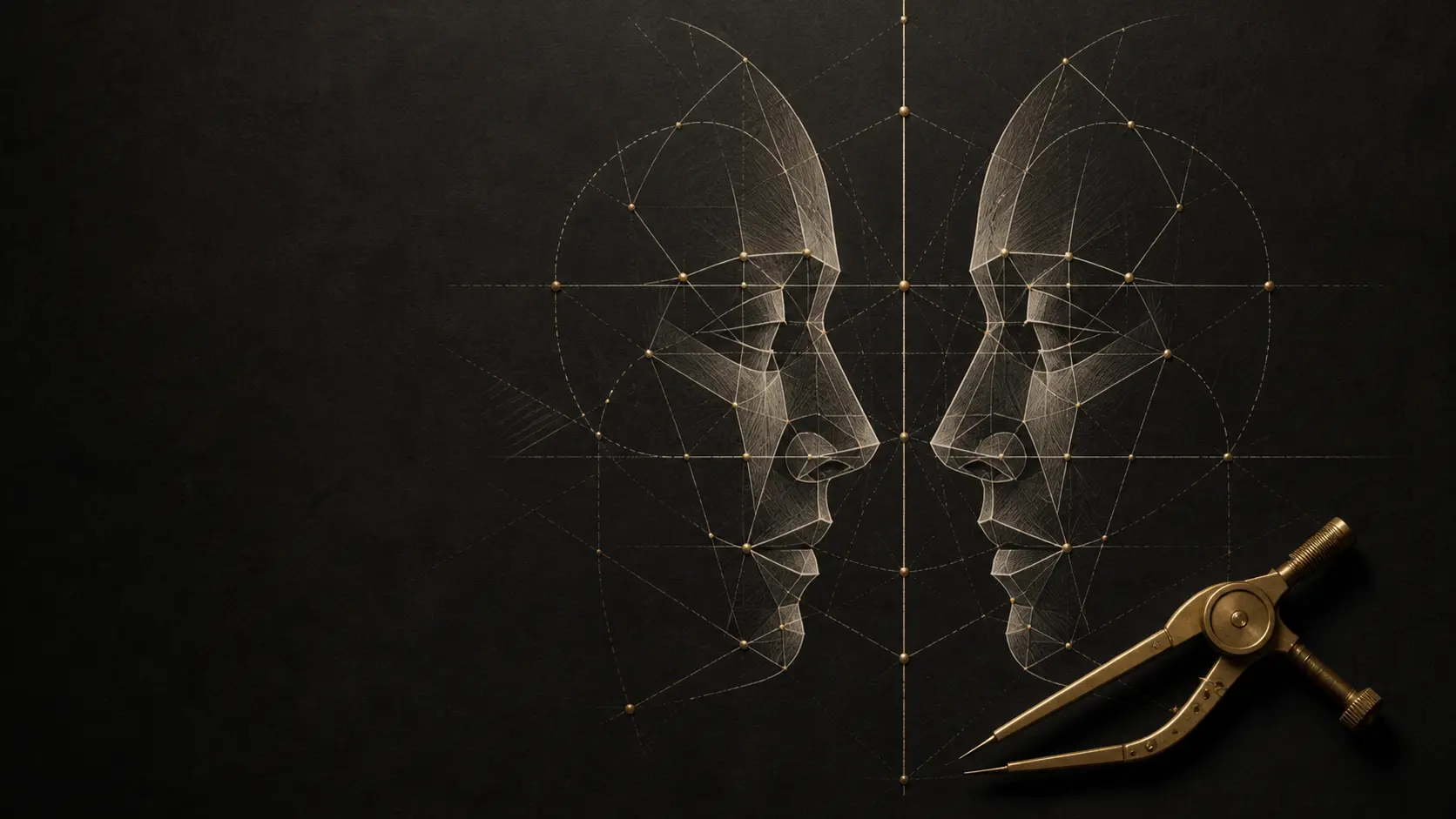
Have you ever looked in the mirror and felt completely fine with how you look, only to switch off mirror mode on your front camera, take a rear-camera snapshot, or try the viral "Mirror Flip Test"—and instantly feel like your face suddenly looks crooked or off-balance?
Many people experience sudden appearance anxiety from this, wondering if something is wrong with their features. In reality, that jarring feeling of unfamiliarity when your reflection is flipped isn't because you suddenly look worse. It's the combined result of optical physics and how your brain processes familiar visual patterns.
In this article, we'll examine the perceptual psychology of visual adaptation alongside the engineering principles of modern 3D facial landmark analysis. By breaking down the fundamental difference between simple "mirror flipping" and AI-driven geometric measurement, we'll help you build an objective, rational understanding of facial harmony.
Why Does Your Flipped Photo Look so Unfamiliar?
To understand this phenomenon, it helps to start with a basic fact: slight facial asymmetry is universal in human anatomy. Whether it's minor differences in eyelid height, eyebrow arch, or jawline contours, subtle variations between the left and right sides of the face are a completely normal part of biological development.
So why do we barely notice these differences in the mirror, yet feel like they're magnified tenfold when a photo is flipped?
1. The Mere-Exposure Effect and Brain "Auto-Correction"
In psychology, a classic principle known as the Mere-Exposure Effect explains much of this phenomenon. In daily life, more than 90% of the times you observe your own face, you are looking at a mirrored reflection.
In 1977, psychologists Mita et al. conducted a famous study (Mita et al., 1977) where participants were shown both true (unmirrored) photos and mirrored photos of themselves. The results were striking: participants consistently preferred their mirrored photos, while their friends and partners preferred their true, unmirrored photos.
This happens because your brain has been conditioned over a lifetime to recognize your mirror image as the familiar, default representation of "you." During mirror viewing, your brain's perceptual system automatically smooths out minor asymmetries. When you look at an unmirrored photograph, that habitual left-right orientation is reversed. Your brain's pattern recognition mechanism experiences a momentary shock, instantly registering a feeling of uncanny unfamiliarity.
2. Camera Focal Length and Perspective Distortion
Beyond cognitive adaptation, physical camera optics play a major role. Smartphone front-facing cameras typically use wide-angle focal lengths (around 24mm to 28mm). When taking close-up selfies, these wide lenses cause perspective distortion—expanding the center of the frame while stretching the edges. When a close-up photo taken under uneven lighting is flipped, this optical distortion stacks on top of natural facial micro-asymmetries, further amplifying the feeling of imbalance.
Mirror Flip Test vs. 3D Landmark Vector Analysis
To gauge their symmetry, many people try "half-face mirror stitching" on social media—splicing the left half of their face, mirroring it to create a full image, and then repeating the process for the right half.
However, this crude, traditional stitching method is fundamentally different from modern AI-driven facial landmark vector analysis in both underlying mechanism and practical value.
| Comparison Dimension | Traditional Mirror Flip Test | 3D Landmark Vector Analysis |
|---|---|---|
| Core Mechanism | Duplicates and horizontally flips one side of the face to stitch a composite | Calculates 3D spatial coordinate vectors across hundreds of key points |
| Technical Foundation | 2D image cropping and horizontal mirror copying | Deep learning face mesh models, such as Google MediaPipe Face Landmarker |
| Visual Output | Often generates two uncanny, unnatural "synthetic faces" | Preserves original facial integrity while overlaying measurement scales and ratio data |
| Focus of Analysis | Pursues absolute left-right mirror alignment | Evaluates overall structural balance and facial harmony relationships |
| Practical Utility | Triggers appearance anxiety with zero objective data support | Delivers quantitative ratio metrics to help understand individual facial contours |
Why Do Mirror-Stitched Faces Look Uncanny?
Perfect symmetry is virtually nonexistent in nature. Research on facial symmetry and attractiveness by Rhodes et al. (Rhodes et al., 1998 / PubMed) found that while higher natural symmetry correlates generally with perceived health and attractiveness, artificially forcing a face into "zero-deviation" absolute symmetry using simple mirror stitching often makes the composite face look unnatural or even uncanny to viewers.
Human facial muscles and skeletal structures operate in subtle dynamic balance. Copying the left side of a face directly onto the right side erases the unique character and natural dynamic balance of your face.
How Does 3D Landmark Vector Analysis Work?
Unlike crude mirror stitching, modern computer vision takes a completely different approach.
Using technologies like Google MediaPipe Face Landmarker, algorithms can construct a real-time 3D Face Mesh comprising over 468 geometric key points from a single 2D image. These landmarks map key anatomical coordinates, including pupil centers, inner eye corners, nasal alar edges, lip peaks, mouth corners, and jawline contours.
Rather than altering the image, the AI system performs objective pixel-level and 3D vector calculations through the following steps:
- Baseline Alignment: Corrects head pose tilt (Pitch, Yaw, Roll) based on the inter-pupillary line or nasal bridge midline.
- Bilateral Distance & Angle Measurement: Measures horizontal distances from facial corners to the center line, mouth corner tilt angles, and bilateral jawline arc symmetry.
- Ratio & Harmony Scoring: Calculates relative deviation ratios between corresponding left and right vectors, rather than making a simplistic binary judgment of "right vs. wrong."
A Scientific Perspective on Symmetry: Structural Harmony Over Mirror Perfection
When discussing facial aesthetics and proportions, it's easy to fall into the trap of assuming that "only perfect left-right symmetry is beautiful." In reality, academic and medical literature (such as Milutinovic et al., 2014) has long confirmed that moderate asymmetry is not only natural, but an essential component of expressive warmth and unique personal identity.
While the Golden Ratio ($\varphi \approx 1.618$) is often referenced in facial proportion studies, it is by no means an absolute rule for judging appearance. Rather than trying to match arbitrary static numbers, it is far more meaningful to understand the relative balance between your forehead, midface, and lower jaw contours.
Chasing "zero-deviation symmetry"—or attempting to alter natural micro-asymmetries through medical or surgical interventions—can often backfire. It is important to distinguish between significant deviations that affect function or structural balance versus natural micro-asymmetries that define personal character.
How to Measure Your Facial Proportions Objectively
If you want to bypass your brain's visual bias and examine your facial structure using objective data, follow these guidelines:
1. Capture a Standardized Photo for Analysis
- Even Lighting: Avoid strong side lighting; choose soft, natural front lighting to minimize deceptive shadows.
- Eye-Level Framing: Keep the camera at eye height at a distance of at least 1 meter (using a rear camera or timer) to avoid close-up wide-angle distortion.
- Neutral Expression: Maintain a relaxed, neutral facial expression with lips lightly closed.
2. Use Secure, Objective Algorithmic Tools
You don't need to upload private personal photos to remote servers for analysis. Modern front-end web technology allows facial landmark algorithms to execute directly inside your web browser.
For example, using the FacialHarmonyAI analysis tool:
- On-Device Local Processing: Image analysis runs locally within your browser, ensuring strict privacy and data security.
- Multidimensional Ratio Metrics: Evaluates approximately 30 anatomical proportion indicators across facial thirds and fifths, focusing on structural harmony rather than toxic rating systems or superficial beauty scores.
- Transparent Service: Provides a free basic preview, with an optional $9.99 one-time complete report for deeper insights (no subscriptions or hidden recurring fees).
It is important to emphasize that analysis results from these tools are strictly for personal exploration and self-understanding, and should never be used as medical diagnosis or surgical planning advice.
Conclusion
The face you see in the mirror and the face captured in a photo are fundamentally the same face viewed through different optical conditions and psychological lenses. The jarring sensation caused by the mirror flip test is largely a temporary illusion triggered when your brain's mere-exposure adaptation is interrupted—it doesn't mean your appearance has changed.
By moving beyond crude half-face mirror splicing and adopting scientific 3D landmark vector analysis and geometric proportion metrics, you can gain a far more rational and comprehensive appreciation of your unique facial structure.
References
- Mita, T. H., Dermer, M., & Knight, J. (1977). Reversed facial images and the mere-exposure hypothesis. Journal of Personality and Social Psychology, 36(8), 598–601. https://psycnet.apa.org/record/1978-10881-001
- Rhodes, G., Proffitt, F., Grady, J. M., & Sumich, A. (1998). Facial symmetry and the perception of beauty. Psychonomic Bulletin & Review, 5(4), 659–669. https://link.springer.com/article/10.3758/BF03208842 / PubMed
- Google AI Edge. MediaPipe Face Landmarker Guide. https://developers.google.com/edge/mediapipe/solutions/vision/face_landmarker
- Milutinovic, J., Zelic, K., & Nedeljkovic, N. (2014). Facial Norms and Facial Symmetry with Improvement of Facial Aesthetics. Journal of Craniofacial Surgery, 25(3), 812–816. https://pmc.ncbi.nlm.nih.gov/articles/PMC3951104/