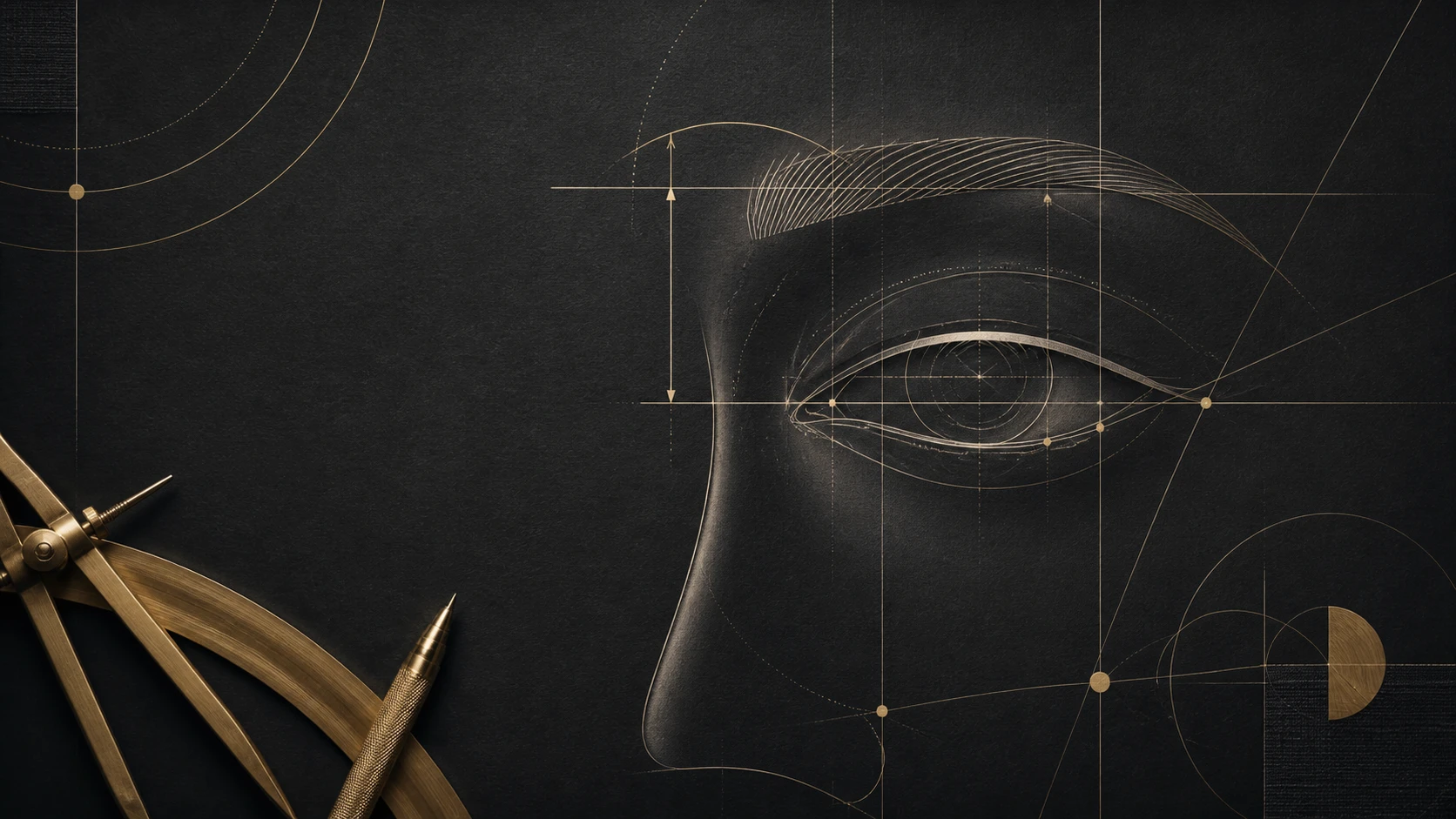
Many people notice that changing their eyebrow shape or grooming routine dramatically alters their overall facial vibe and proportions. This isn't an illusion—in facial proportion analysis, brow-to-eye vertical distance (Brow-to-Eye Distance) serves as a central visual pivot connecting the upper face and the midface focal center.
While aesthetic discussions frequently focus on eye size or brow arc shape, what truly dictates the impression of openness versus compression across the upper-mid face is the vertical landmark spacing between the lower border of the eyebrow and the upper eyelid margin, combined with the physical placement of the bony orbit itself.
In this guide, we examine brow-to-eye positioning through an anthropometric lens: covering standard measurement protocols, its impact on perceived midface length, and how orbital placement interacts with palpebral inclination (Palpebral Inclination).
Measuring Brow-to-Eye Distance: Key Landmarks and Vertical Baselines
Accurately evaluating brow height requires eliminating distortions from camera angles or facial expression muscle tension (such as brow raising or furrowing). Standard anthropometric evaluations position subjects in Natural Head Position (Natural Head Position, NHP), maintaining a straight-ahead gaze.
Key measurement landmarks include:
- Supraorbital Rim Lower Border (Supraorbital Rim Lower Border): The lower bony margin of the orbit palpable above the eye, representing the anatomical hard-tissue upper boundary.
- Inferior Brow Border (Inferior Brow Border): The lower skin-hair boundary of the eyebrow (typically measured directly above the mid-pupillary line).
- Superior Palpebral Margin (Superior Palpebral Margin): The upper edge of the upper eyelid where skin meets the eyeball (the margin overlapping the top of the cornea).
The standard vertical brow-to-eye distance refers to the vertical millimeter measurement from the inferior brow border to the superior palpebral margin along the mid-pupillary line.
Crucially, eyebrows are soft-tissue structures that shift with age, facial expressions, and grooming habits, whereas the supraorbital rim serves as a relatively static skeletal reference. Therefore, a thorough assessment considers both soft-tissue brow height and bony orbital rim positioning.
How Brow Height Shifts Perceived Midface Length
Facial analysis traditionally divides the face into vertical thirds (rule of thirds). Typically, the upper third spans from the hairline to the glabella, while the middle third spans from the glabella to the subnasale.
However, human visual perception does not scan strictly according to bony landmarks when judging midface length. Instead, the eyebrows serve as the perceived visual upper boundary of the midface. This creates two distinct visual effects:
- High Brow Position (Wide Brow-to-Eye Gap): Lengthens the visual transition zone from the brows to the eyes, creating an airy, open midface upper border. In some cases, an exceptionally wide gap can make the upper face appear disproportionately large or convey a perpetual look of surprise or neutrality.
- Low Brow Position (Hooded/Compressed Brow Impression): When eyebrows sit low against the supraorbital rim, visual focus on the orbital area intensifies, creating a deep, intense gaze. However, if the spacing is excessively tight, it can make the midface feel constricted or visually accentuate the length of the nasal bridge.
In an anthropometric study by Milutinovic et al., 2014, researchers evaluated facial photographs of 83 average women and 24 highly attractive women. The study revealed that attractive facial groups displayed greater overall balance across facial thirds and fifths. More importantly, the authors emphasized the value of harmonious proportion and uniformity rather than extreme absolute values. For a deeper look into eye spacing and horizontal harmony, see our analysis on Facial Fifths and Eye Spacing.
Combined Effects of Palpebral Inclination and Orbital Positioning
Brow-to-eye distance does not exist in isolation; it interacts with orbital depth and palpebral inclination (Palpebral Inclination) to define periorbital geometry.
Palpebral inclination is the angle formed by a line connecting the inner canthus to the outer canthus relative to the true horizontal axis:
- Positive Tilt (Positive Tilt): The outer canthus sits higher than the inner canthus, drawing visual energy upward and imparting a dynamic or sharp impression.
- Negative Tilt (Negative Tilt): The outer canthus sits lower than the inner canthus, shifting the visual weight downward.
When a wide brow-to-eye distance coincides with a positive tilt, the upper-mid face appears spacious with substantial eyelid exposure. Conversely, when a narrow brow-to-eye distance joins a negative tilt, the downward pressure between the brow bone and outer eye corner becomes significantly more pronounced.
As noted in the QOVES Proportionality Guide, empirical measurements based on Farkas anthropometric standards often diverge from classical aesthetic canons. Real-world populations exhibit immense variation in orbital inclination and brow-to-eye spacing across diverse ancestries and genders. Comprehensive normative data on periorbital skeletal morphology is also documented in the NCBI Orbital Anthropometry Study.
Golden Ratios Are Clues, Not Rigid Rules
Some aesthetic formulas attempt to apply the Golden Ratio ($\phi \approx 1.618$) to dictate the ideal relationship between brow arch peak and eye width. However, modern facial geometry research offers no evidence that a single fixed ratio constitutes a universal standard of beauty.
The true goal of facial analysis lies in proportional harmony:
- Forehead Height vs. Brow Gap: A broad forehead often pairs well with a moderately spacious brow-to-eye distance to prevent top-heavy proportions, while a low hairline with an overly wide brow gap can visually crowd forehead space.
- Orbital Depth and Shadowing: Deep-set eyes naturally cast shadows under low brows, adding dimensional structure. Shallow orbits with low brow placement, on the other hand, can create a heavy appearance.
How to Objectively Assess Your Brow-to-Eye Proportions
Evaluating your brow-to-eye balance doesn't mean forcing artificial changes or pursuing unrealistic standards. The most practical approach is analyzing your relative midface geometry under neutral lighting and a natural head posture.
If you want an objective measurement of your facial proportions, try the FacialHarmonyAI Self-Test Tool. By uploading an evenly lit front-facing photograph, our browser-side algorithms analyze approximately 30 forehead and midface landmark metrics.
Key features include:
- Focus on Proportional Relationships: Analyzes brow-to-eye vertical height, eye tilt, and forehead landmarks without superficial attractiveness scoring or shaming.
- Complete Privacy: All facial landmark parsing occurs locally within your browser—your photo is never uploaded or stored.
- Flexible Exploration: Includes a free instant preview, with an optional $9.99 one-time Atelier comprehensive report for detailed proportional analysis (no subscription required).
Understanding your skeletal landmarks and soft-tissue relationships empowers you to make informed styling choices—whether shaping eyebrows, applying makeup, or selecting eyeglass frames suited to your unique structure.
References
- Milutinovic J, Zelic K, Nedeljkovic N. (2014). Evaluation of facial beauty using anthropometric proportions. TheScientificWorldJournal. PMC3951104
- QOVES Insights. Facial Proportionality: An Evidence-Based Guide. QOVES Guide
- Packiriswamy V, et al. (2010). Anthropometric Assessment of Orbital and Periorbital Radii. PMC Journal of Anatomy. PMC2825126