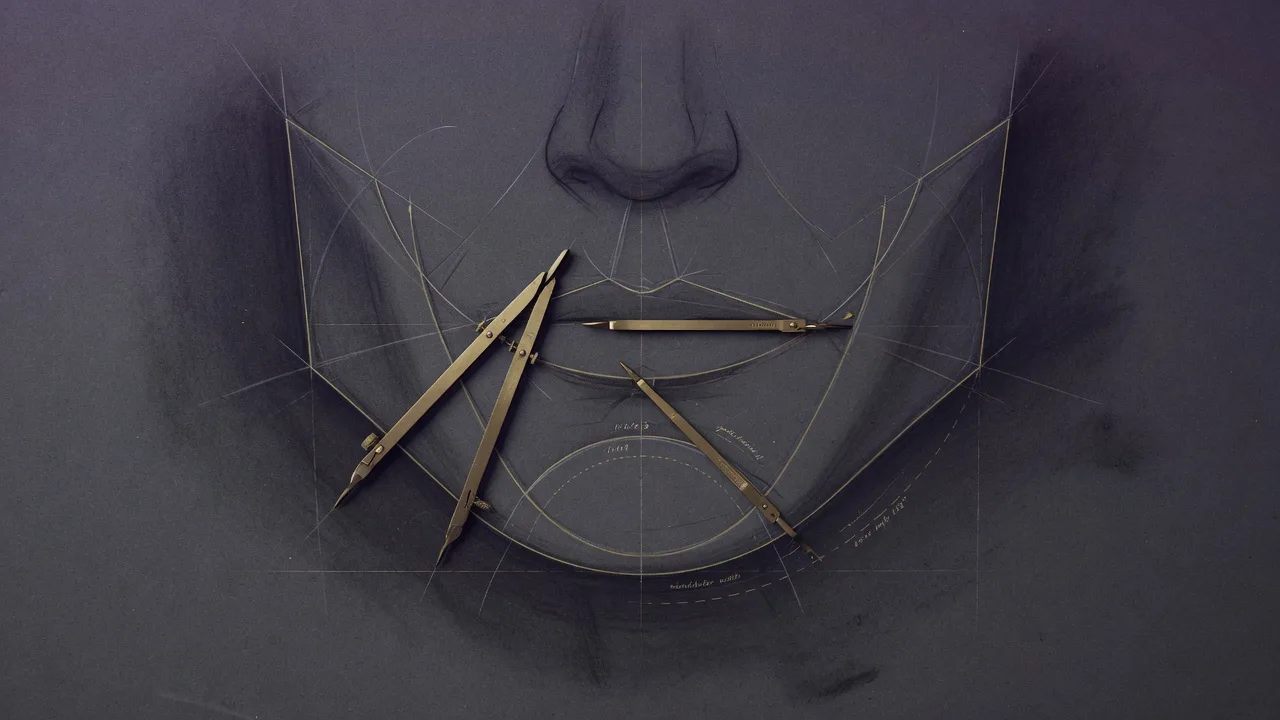
When looking at frontal photos or examining your profile in the mirror, it is common to wonder: "Does my jaw look too square or broad?" or "My lower face seems narrow—is it out of proportion?"
In anthropometry, however, the visual prominence of the jaw is never determined in isolation. Whether a jawline appears strong or delicate depends primarily on its proportional relationship to the widest part of the face—the cheekbones (bizygomatic width). Grounded in geometric analysis and population data, this article breaks down the science behind jaw width and facial proportions, helping you objectively understand your facial structure without medical assumptions or surgical anxiety.
A Geometric Perspective: Two Key Landmarks and Architectural Analogies
To quantify the relative visual width of the jaw, anthropometric studies rely on two key benchmark measurements:
- Bizygomatic Width: The horizontal distance across the widest section of the face, typically measured between the most lateral prominent points of the zygomatic arches.
- Bigonial Width: The horizontal distance between the left and right gonial angles (the corners of the jaw mandible).
If you think of the facial contour as an architectural structure, the bizygomatic width acts like the widest overhang of the roof, while the bigonial width represents the foundation. Whether a structure conveys grounded stability or slender vertical elevation depends significantly on this foundation-to-roof width ratio—known as the Bigonial-to-Bizygomatic Ratio.
- Higher Ratios (approx. 0.75–0.82): The jaw width closely approaches the cheekbone width, producing a distinct rectangular or soft-square outline that carries a strong structural presence.
- Moderate Ratios (approx. 0.70–0.75): The jawline gently tapers inward, forming a classic oval or heart-shaped facial contour.
- Lower Ratios (below approx. 0.65–0.70): The jaw is relatively narrow, shifting the visual focus upward toward the eyes and cheekbones.
All three configurations are widely represented across healthy human populations. Each supports a distinct facial character and balance; none is inherently superior or inferior to another.
Classical Canons vs. Modern Anthropometric Data
During the Renaissance, classical aesthetic canons attempted to reduce ideal human beauty to rigid geometric formulas, often invoking concepts like the Golden Ratio ($\phi$). However, modern academic research and anthropometric surveys—such as the pioneering work of Dr. Leslie Farkas—consistently demonstrate a vast disconnect between artistic dogma and real-world skeletal variation.
In a landmark study by Milutinovic et al. (2014) published in TheScientificWorldJournal, researchers analyzed frontal photographs taken in the Natural Head Position (NHP). They compared 83 young Caucasian women aged 22–28 from a general university sample (University of Belgrade) against 24 widely recognized female public figures. Their findings highlighted key structural patterns:
- The public figures group exhibited greater overall symmetry and uniformity in facial thirds and fifths, alongside slightly more compact contours overall.
- However, when evaluating the specific jaw-to-cheekbone ratio, both groups demonstrated a broad, overlapping range of normal population variance.
In short, there is no single "ideal jaw ratio." What renders a facial contour harmonious is the holistic relationship between jaw width, lower facial height (the lower third), mouth width, and neck transition line—rather than an arbitrary, rigid numerical metric.
Key Guidelines for Self-Measurement on 2D Frontal Photos
If you want to estimate this ratio from your own frontal photograph, keep in mind the optical limitations of two-dimensional imaging. To obtain reliable, repeatable data, follow these guidelines:
1. Photo Capture Protocol (Natural Head Position)
- Eye-Level Camera Alignment: Avoid tilting your head up or down. Looking down artificially narrows the jaw, while looking up inflates lower-face breadth.
- Relaxed Facial Muscles: Maintain a neutral bite without clenching your back teeth (clenching flexes the masseter muscle, falsely inflating jaw width) or straining the chin muscles.
- Minimize Focal Distortion: Stand at least 5 feet (1.5 meters) away from the lens and use telephoto zoom or crop the image. Close-up wide-angle selfies distort perspective, causing central facial inflation.
2. Measurement and Calculation Steps
- Locate the outermost lateral boundaries of the zygomatic arches on your photo and record the pixel distance as $W_{bizygomatic}$.
- Identify the outermost prominent points at the mandibular angles (gonion points) and measure the pixel distance as $W_{bigonial}$.
- Calculate the ratio:
$$\text{Jaw Width Ratio} = \frac{W_{bigonial}}{W_{bizygomatic}}$$
- Evaluate this ratio alongside your lower facial third height (for a detailed refresher on calculating vertical facial proportions, see our Facial Thirds Measurement Guide).
Whether your result is 0.68 or 0.79, both fall comfortably within the documented normal distribution spectrum of human anthropometry.
Rejecting Beauty Scoring Systems and Medical Misconceptions
The internet is replete with automated "attractiveness calculators" and aggressive facial re-contouring guides. Many crude scoring algorithms penalize broader jawlines automatically, stoking anxiety around jaw shaving, masseter injections, or surgical osteotomies.
Two critical facts must be kept in mind:
- 2D Geometry is Not a Clinical Diagnosis: Analysis of a 2D photograph provides only a flat, frontal projection of facial proportions. It cannot evaluate three-dimensional bone density, masseter muscle thickness, subcutaneous adipose tissue, or dental occlusion. Any invasive procedural decisions require formal clinical consultation and 3D CT diagnostics from licensed healthcare professionals.
- Overall Balance Trumps Single Metrics: A structured, grounded jawline is often the defining hallmark of striking, high-character facial balance. Isolating a single width ratio without considering eye spacing, vertical proportions, and negative space is clinically and aesthetically meaningless.
Explore Your Facial Geometry with FacialHarmonyAI
If you prefer not to plot landmarks and calculate pixel ratios manually, you can explore your facial proportions with FacialHarmonyAI.
We provide objective, neutral geometric analysis—completely free of arbitrary rating scores or medical upsells:
- Browser-Native Privacy: Facial landmark detection runs locally within your browser using client-side algorithms. Your photos are never uploaded, stored, or harvested for machine learning models.
- Free Instant Preview: Instantly view core structural benchmarks—including your bigonial-to-bizygomatic ratio and vertical facial thirds—to build an objective understanding of your outline.
- Comprehensive Atelier Report ($9.99 One-Time): For a deeper analysis, the complete Atelier report evaluates roughly 30 frontal plane geometric metrics against broader population variance data, giving you an exhaustive analytical dossier with no recurring subscriptions.
Ready to explore your facial structure through a clear, scientific lens? Visit the FacialHarmonyAI Testing Suite to begin.