
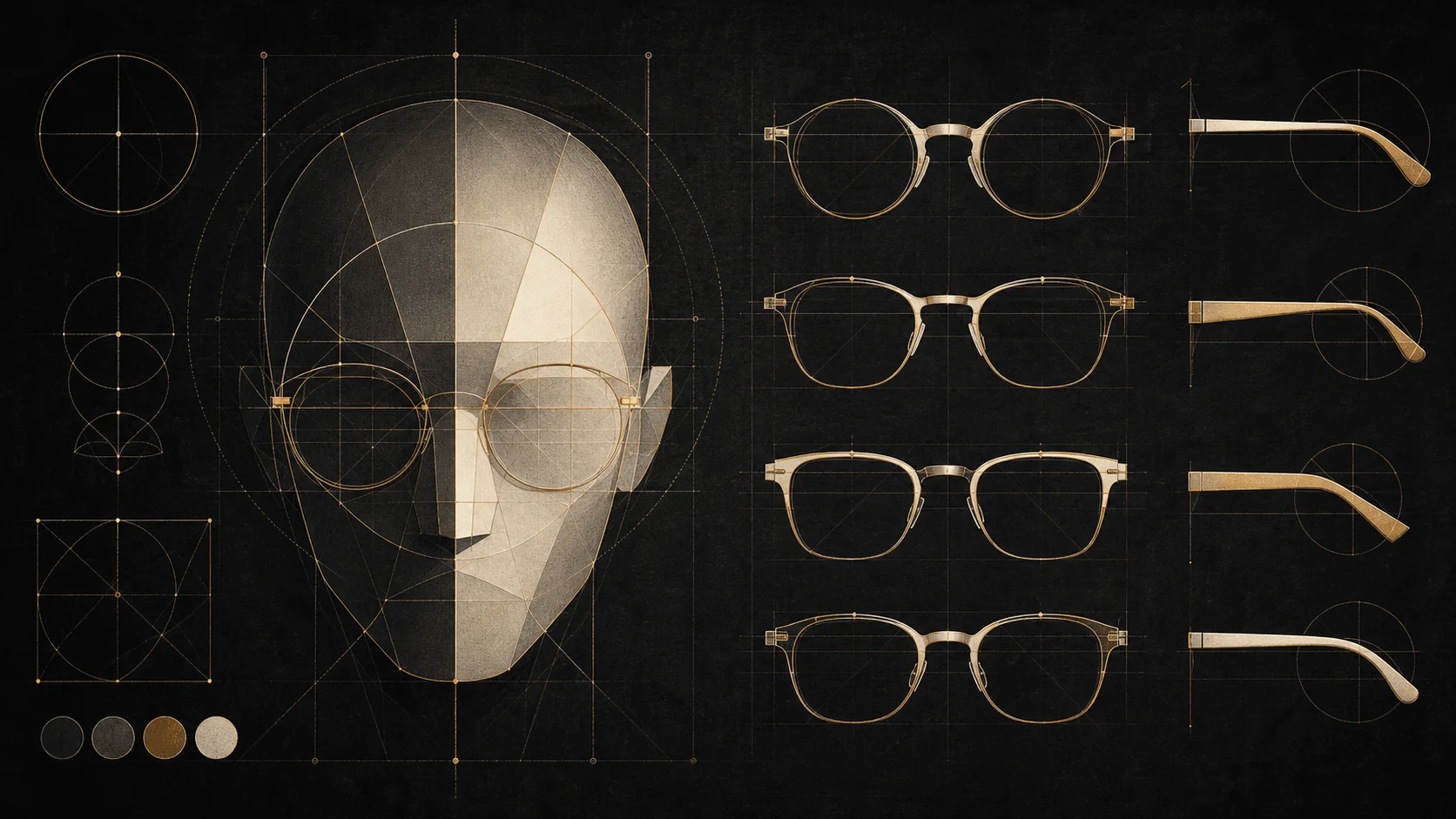
When shopping for glasses, almost everyone encounters classic advice like "wear square frames for a round face, and round frames for a square face." Yet in the fitting booth or at home, that rule frequently breaks down—why can a trendy oversized frame make your midface look stretched while pushing your eyes visually together?
The reason is simple: eyeglass frames act as a secondary structural border layered over your natural facial geometry. What truly determines whether a frame flatters your features isn't a rigid face-shape label, but how the frame's physical dimensions interact with your horizontal (facial fifths) and vertical (facial thirds) proportions.
Before diving in, keep one essential distinction in mind: facial proportions provide objective styling references for visual balance and optical illusions—they are neither medical diagnostic tools nor rating scales for beauty. Grounded in anatomical measurement research, this guide outlines an objective, proportions-based approach to finding frames that truly fit.
Why Do Classic Face-Shape Rules Keep Failing You?
Traditional guides assume faces fit into neat categories like round, oval, or square. In practice, two people with "oval" faces can have completely different nose bridge widths, midface lengths, or inter-eye spacing. Focusing strictly on outer contour ignores how the frame divides the inner canvas of your face.
By focusing instead on key geometric metrics—such as bridge width relative to eye spacing and rim height relative to midface length—you can select frames that harmonize with your features rather than fighting them.
How Do Facial Fifths and Eye Spacing Determine Bridge Width?
The standard baseline for horizontal facial layout relies on the "rule of fifths." In visual perception research, an experimental study by Pallett et al. (PMC2814183) highlighted how relative spatial relationships between features strongly influence visual attractiveness and harmony. Additional coverage by Medical Xpress examined psychophysical baseline standards tested in specific cohorts—such as vertical eye-to-mouth distance relative to face length (around 36%) and inter-ocular spacing relative to face width (around 46%). While these figures demonstrate how sensitive the human eye is to proportional balance, they should be viewed as general reference points for optical illusion design rather than unbending aesthetic rules.
When choosing frames, your horizontal proportions dictate Frame Bridge Width and where your pupils sit relative to the lens optical centers:
- Close-Set Eyes (Intercanthal Distance Under 1 Eye Width): If your inner eye distance is relatively narrow, picking a wide bridge (e.g., above 20mm) or a thick, dark bridge visually accentuates tight spacing or creates an awkward contrast. Opt for a narrower bridge (around 15–17mm) made from visually subtle materials like fine titanium. Frames with subtle outer-corner extensions (such as a soft cat-eye or elongated endpieces) help pull visual focus outward. For more detail, explore our guide on facial fifths and eye spacing proportion analysis.
- Wide-Set Eyes (Intercanthal Distance Over 1 Eye Width): Select a visually prominent bridge (a bold keyhole design, wider bridge span, or double bridge). Bringing visual weight to the center creates a natural focal point between the eyes, balancing wider spacing.
As a general guideline, overall Frame Width should align closely with the widest part of your face (typically near the cheekbones or temporal points). Frames that extend too far past your temples or pinch inward disrupt natural structural proportions.
How Does Frame Height Balance a Long or Short Midface?
In facial morphology analysis, research published in MDPI Symmetry (MDPI 2073-8994/9/12/294) provided quantitative studies on facial proportion measurement and compositional uniformity. The research indicates that balanced proportions across the facial thirds (upper, middle, and lower) foster a heightened sense of visual harmony.
Because glasses sit directly across the midface, they act as a prominent visual divider regulating vertical proportions:
- Long Midface (Higher Subnasale-to-Subcallosal Ratio): A longer midface projects sophistication, but standard shallow frames can leave the central face looking elongated or empty. Frames with greater vertical rim height (Rim Height 40mm+) help fill this central space. Additionally, selecting a style with a low bridge point lowers the vertical visual anchor, visually shortening the midface through optical illusion.
- Short Midface: Choose shallower rim heights (narrower frames, rimless, or semi-rimless designs) paired with a high bridge point. This keeps midface space open and prevents the bottom rim from visual crowding near the nose and upper lip.
- Long Upper Third / High Forehead: Styles featuring prominent top rims (such as browline frames or bold top bars) anchor visual weight near the upper-to-middle third boundary, restoring balance to a higher forehead.
Which Frame Dimensions Match Your Proportions?
To translate these proportional principles into practical frame shopping, reference the matrix below:
| Facial Proportional Feature | Spatial Indicator | Key Metric to Watch | Recommended Frame Geometry | Styles to Avoid |
|---|---|---|---|---|
| Close-Set Eyes | Inner fifth < 1 eye width | Narrow Bridge (15–17mm) | Delicate bridge, subtle outer wing extensions, light metal frames | Wide dark bridges, heavy double bridges |
| Wide-Set Eyes | Inner fifth > 1 eye width | Wider Bridge (18–21mm) | Bold keyhole bridge, double-bridge frames | Minimal/invisible bridge designs, narrow bridges |
| Long Midface | Midface proportion > typical range (~36%) | Generous Lens Depth (Height 40mm+) | Deep vertical frames, low bridge placement, rounded bottom rims | Ultra-shallow rectangular frames, high slim bridges |
| Short Midface | Midface proportion < typical range (~30%) | Shallow Lens Depth (Height < 33mm) | Narrow profiles, rimless/semi-rimless, high bridge placement | Oversized aviators covering the mid-cheek |
| Wider Face Contour | Face width / height ratio > 0.75 | Extended total frame width | Geometric polygons, subtle angled rectangular frames | Tiny round frames, thick undersized square frames |
How Can You Measure Your Proportions Accurately?
Trying to measure facial ratios with a tape measure in front of a mirror often leads to errors caused by perspective distortion and viewing angles. Manual measurement can be tedious, but modern browser technology makes geometric checking far simpler.
At FacialHarmonyAI, you can upload a straight-on portrait to evaluate key landmark points entirely within your local browser engine. The system calculates roughly 30 geometric indicators—including facial thirds balance, intercanthal distance, and aspect ratios.
- Free Preview: Check your baseline facial thirds and fifths proportions.
- Sample Report: Review the FacialHarmonyAI Sample Report to see how individual parameters correspond to frame recommendations.
- Full Atelier Report: For an in-depth breakdown covering frame selection alongside hairstyle proportions, an optional $9.99 report is available (one-time purchase, non-subscription). Your photos are processed locally and are never stored on external servers.
Eyewear shouldn't serve as a mask to hide behind—it's an intentional design tool to complement your natural facial geometry. Once you know your key proportions, frame selection becomes a straightforward choice.
References
- Pallett, P. M., Link, S. T., & Lee, K. (2010). New golden ratios for facial beauty. Vision Research, 50(2), 149-154. PMC Full Article
- Medical Xpress. (2009). Researchers discover new 'golden ratios' for female facial beauty. News Report
- MDPI. (2017). Facial Measurements, Proportions and Attractiveness. Symmetry, 9(12), 294. MDPI Article Link