
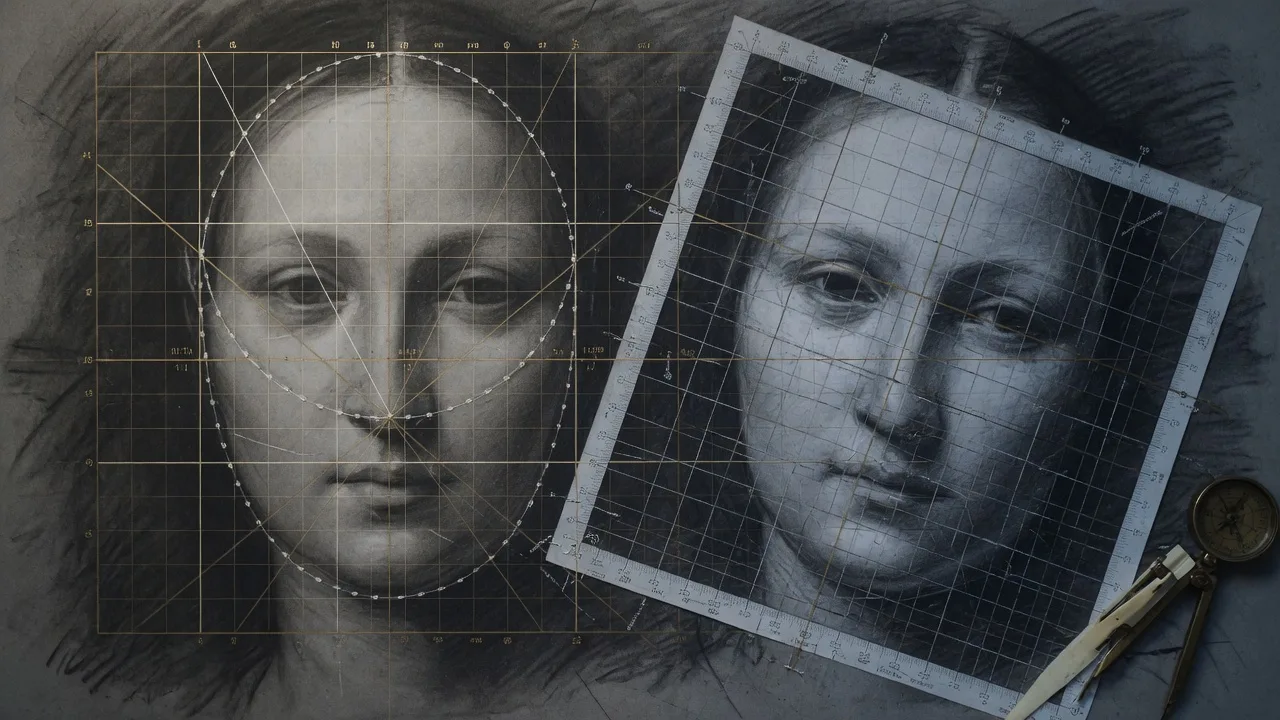
When discussing facial proportions and aesthetics, the first image that comes to mind for many people is often a Renaissance sketch by Leonardo da Vinci or Albrecht Dürer: the forehead, nose length, and chin perfectly divided into thirds; the facial width precisely split into five equal eye widths.
These rules, known as Classical Facial Canons, dominated artistic creation and aesthetic standards for centuries. However, when Dr. Leslie Farkas—a pioneer of modern facial anthropometry—and his research team actually picked up calipers to take precise measurements of thousands of real human faces, they arrived at a groundbreaking conclusion: true natural faces rarely fit these perfect geometric assumptions.
Which model better explains facial harmony and attractiveness? This article explores the deep contrast between classical artistic canons and modern empirical data led by Farkas anthropometry.
1. From Artistic Ideals to Scientific Measurement: Fundamental Differences
To understand this centuries-long debate on facial proportions, we first need to clarify the fundamental premises of both approaches:
- Classical Facial Canons: Stemmed from the artistic demands of the Renaissance and Neoclassical eras. Painters and sculptors summarized geometric guidelines based on simple integer ratios (such as 1:1:1 or 1:5) to efficiently recreate harmonious human figures on canvas or in stone. Their nature is prescriptive—telling people how an ideal face should look.
- Farkas Anthropometry: Grounded in modern biometrics and anatomy. By measuring physical distances and angles between specific anatomical bony landmarks on the face, it documents morphological traits across real populations. Its nature is descriptive—using statistical methods to reveal how real human faces actually look.
Comparison Matrix: Classical Canons vs. Empirical Anthropometry
| Dimension | Classical Facial Canons | Farkas Anthropometry & Modern Research (Empirical Anthropometry) |
|---|---|---|
| Core Theory | Rigid integer geometric divisions (e.g., rule of thirds, rule of fifths) | Continuous numerical ranges and variance based on population distribution |
| Data Basis | Artistic intuition, philosophical ideals, and geometric aesthetics | Statistical measurements of thousands of real facial anatomical landmarks |
| Fault Tolerance | Extremely low (presumes deviation as flaw, expecting 100% adherence) | High (allows natural variations, emphasizing co-adaptation across multi-dimensional ratios) |
| Facial Adaptability | Single rigid standard, failing to accommodate ethnic and individual differences | Respects anatomical diversity across ethnicities, genders, and age groups |
| Modern Application | Introductory art instruction, basic composition reference | Modern facial harmony analysis, orthodontics, anatomical research, and algorithmic computation |
2. Revealing Population Realities: Do Perfect "Thirds" and "Fifths" Exist?
Among classical canons, the two most famous rules are the "Vertical Rule of Thirds" and the "Horizontal Rule of Fifths":
- Rule of Thirds: Equal vertical length from hairline to interbrow point (Trichion - Nasion), Nasion to nasal base (Nasion - Subnasale), and Subnasale to bottom of the chin (Subnasale - Menton).
- Rule of Fifths: The widest part of the face equals exactly five horizontal eye-widths, with intercanthal distance equal to single palpebral fissure width.
However, after measuring large populations of healthy individuals without facial deformities, Professor Farkas discovered that the proportion of people who perfectly match classical fifths or thirds is extremely low in the general population. The vast majority of aesthetically pleasing individuals exhibit slight non-equal deviations across their facial thirds or fifths.
Modern Empirical Research: Findings from Milutinovic et al. (2014)
In a 2014 study published by Milutinovic et al. (TheScientificWorldJournal, r04), researchers compared the facial images of 83 ordinary women (from the University of Belgrade) with 24 women widely recognized as highly attractive.
The study revealed:
- Attractiveness vs. Uniformity: High-attractiveness faces demonstrated greater consistency and balance in the "thirds" and "fifths" zones, paired with overall smaller, more compact facial contours.
- Non-Absolute Standards: Even faces universally regarded as highly attractive did not mechanically hit the absolute 33.3% division mark; instead, they exhibited a dynamic balanced distribution.
This confirms a crucial insight: mathematical "absolute equality" is not a prerequisite for beauty—overall facial harmony is what truly matters. To learn more about scientific evidence surrounding facial balance, check out our Facial Harmony Evidence Guide.
3. Why the Golden Ratio (φ) Is Not a Simple Formula for Facial Beauty
Beyond Renaissance canons, popular culture often promotes the Golden Ratio (φ ≈ 1.618) as the "single golden standard" for evaluating facial attractiveness.
From a scientific standpoint, this view is similarly oversimplified:
- Research Clues, Not Absolute Formulas: While the Golden Ratio occasionally appears in nature and in specific facial features (such as certain vertical-to-horizontal ratios), it serves more as an observational research clue than an all-encompassing law.
- Overfitting Risk: Forcing a Golden Ratio mask onto every individual ignores the unique charm of human facial diversity (e.g., round, square, or heart-shaped faces).
As we explored in our article on Golden Ratio Face Myths vs. Analytical Frameworks, modern facial analysis has shifted from "searching for a single sacred constant" to "analyzing relative proportions and contextual relationships across multi-dimensional features."
4. From Absolute Scores to Multi-Dimensional Harmony: The Evolution of Modern Facial Analysis
From the absolute geometry of classical art to Farkas's empirical anthropometry, modern aesthetics and facial analysis techniques have undergone a paradigm shift.
Past misconceptions often involved:
- Shame-Based Scoring: Defining an entire face with a single arbitrary number (e.g., "6/10"), an approach that lacks scientific backing and induces aesthetic anxiety.
- Isolated Landmark Bias: Focusing solely on nose length or eye size while ignoring how features harmonized with the underlying facial architecture.
Modern scientific frameworks emphasize Facial Harmony: assessing how parameters—such as frontal plane ratios, midface convexity, mandibular breadth, and intercanthal distance—work synergistically as a whole.
How Technology Helps You Understand Your Facial Proportions
At FacialHarmonyAI, we built a multi-dimensional facial proportion analysis tool grounded in modern anthropometry and computer vision principles:
- Privacy-First In-Browser Analysis: Simply upload a front-facing photo. All facial landmark extraction and ratio calculations occur directly in your browser. Photos are never uploaded or stored on servers, ensuring complete privacy.
- ~30 Frontal & Facial Plane Proportional Metrics: Moving away from crude beauty scores, we focus on evaluating roughly 30 objective metrics including vertical thirds distribution, midface width, and eye-to-face ratios.
- Non-Medical & Non-Surgical Orientation: We do not provide medical diagnoses or surgical planning recommendations. Instead, like a knowledgeable guide, we help you objectively understand your unique facial structure and harmony highlights.
- Flexible Experience: Try our free preview; if you want a complete Atelier Report with detailed proportion parameters and structural insights, get full access for a $9.99 one-time payment (no subscriptions, no hidden fees).
Conclusion: Discover Your Own Dynamic Balance
Classical facial canons left us with valuable aesthetic intuitions, while Farkas anthropometry grounded us in the physical reality of human biology with empirical data.
Understanding facial proportions is never about forcing yourself into a Renaissance canvas grid. It is about clearly recognizing your own unique structural traits to discover the style expression that suits you best. True facial harmony is always built on a scientific foundation that respects authentic human diversity.