FacialHarmonyAIFacialHarmonyAI
Guides

FacialHarmony vs FaceShapeLab: Which Face Analysis Tool Fits You?

FaceShapeLab is strong for fast face-shape classification and styling ideas, while FacialHarmony focuses on interpretable facial proportions, symmetry, evidence, confidence checks, and follow-up improvement paths. Here is how to choose.

FacialHarmonyAI Editorial TeamAugust 3, 202612 min read
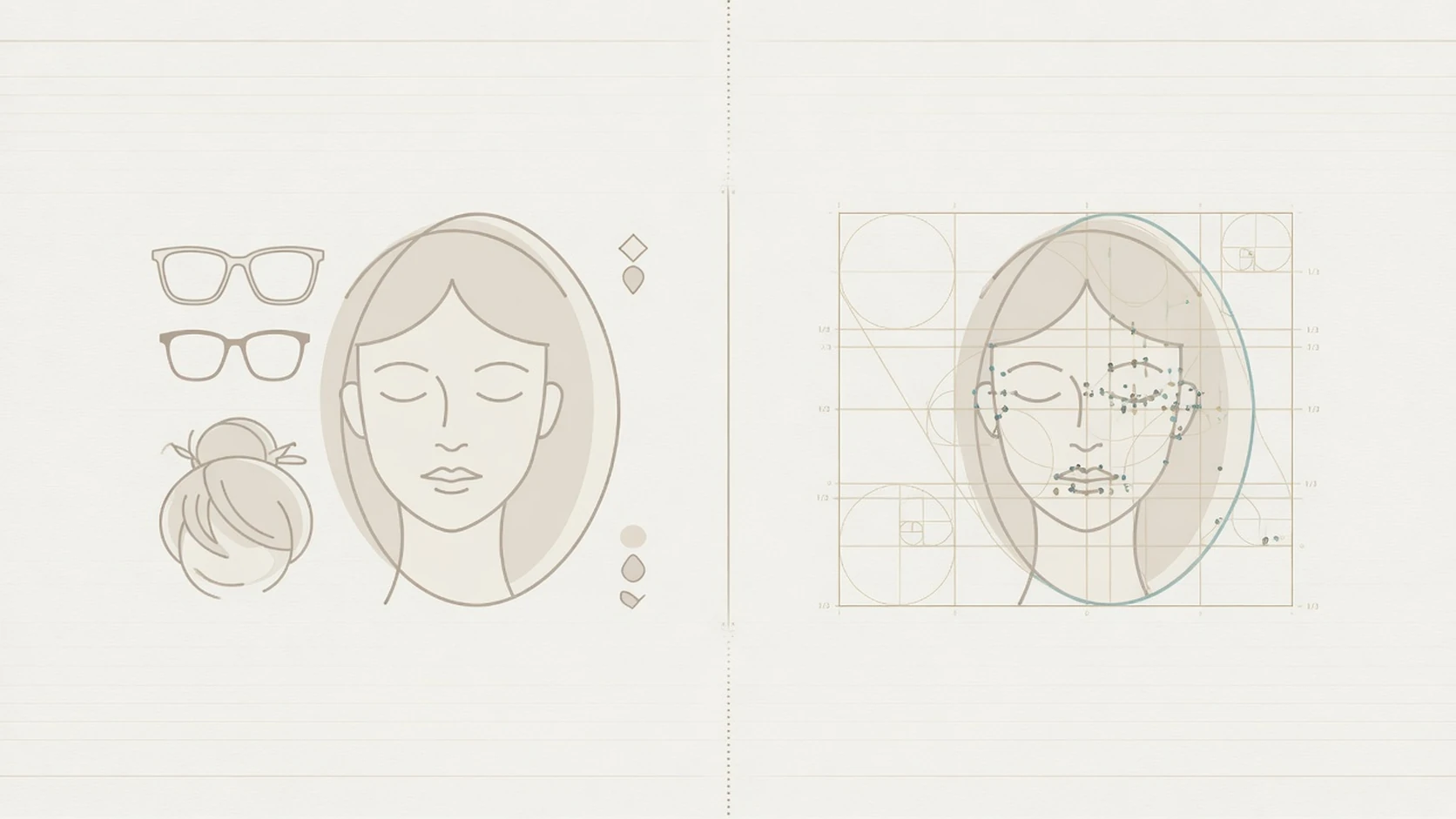
Side-by-side illustration: face-shape styling cues versus multi-ratio harmony mapping

Executive Summary

FacialHarmony and FaceShapeLab overlap, but they are not primarily designed to answer the same question.

FaceShapeLab is the better first stop when your main question is practical and immediate: “What face shape does this photo resemble, and what hairstyles, glasses, beard styles, or grooming choices might work with it?” Its core experience emphasizes fast face-shape classification, mixed-shape probabilities, styling recommendations, a dashboard-style report, and a collection of additional face-analysis tools. Its official website describes a scan taking less than 30 seconds, while its current pricing page lists a free tier with limited scans and starter grooming recommendations.

FacialHarmony is the better fit when your question is analytical: “How do the proportions in this frontal photo relate to one another, how trustworthy is the measurement, and what should I examine next?” Its example report organizes approximately 30 frontal ratios into seven categories, including facial thirds, face shape, eyes, brows, nose, mouth, and jaw and chin. It also shows measured values, reference ranges, score impact, visual evidence, confidence, and a front-facing pose gate rather than presenting an unexplained result alone.

The most useful decision rule is therefore:

Quick face shape and styling → FaceShapeLab-type tools. Proportions, symmetry, three vertical facial thirds, evidence, confidence checks, and follow-up → FacialHarmony.

This is not a declaration that one product is universally superior. FaceShapeLab offers more breadth than a basic shape detector—including a separate symmetry tool that reports symmetry, facial thirds, golden-ratio comparisons, regional alignment, and styling guidance. FacialHarmony’s advantage is not that FaceShapeLab measures nothing beyond shape; it is that FacialHarmony’s central product is structured around multi-ratio interpretation, evidence, photo-quality gates, and an improvement path.

Neither tool should be treated as a medical assessment, an objective measurement of attractiveness, or a judgment of personal worth. Both companies describe their results as informational estimates affected by pose, lighting, expression, image quality, and camera conditions.

Head-to-Head Comparison

AreaFaceShapeLabFacialHarmonyPractical meaning
Primary jobFast face-shape identification followed by styling and grooming guidance. The broader platform also offers symmetry, age, eye, nose, lip, expression, and similar-face tools.Interpretable frontal facial-harmony analysis: proportions, facial thirds, spacing, symmetry signals, category relationships, evidence, and follow-up suggestions.Choose according to the question, not the number of features on the landing page.
Best first question“What is my likely face shape, and which styles could complement it?”“How do the visible relationships among my facial features work together in this photo?”FaceShapeLab starts with a label and styling use case; FacialHarmony starts with relationships and interpretation.
Speed and convenienceOfficially describes a three-step flow completed in under 30 seconds and supports web and Android use.Starts with a browser-first free scan and preview, followed by an optional paid full report.FaceShapeLab is optimized for low-friction curiosity and styling decisions. FacialHarmony asks the user to spend more time reading a report.
Face-shape outputClassifies against common geometric categories such as oval, round, square, heart, diamond, oblong, and triangle. The dashboard description says reports can include mixed face-shape probabilities rather than only one label.Includes face shape as one category inside a broader harmony analysis. Its dedicated Face Shape Test emphasizes contour direction, mixed labels, confidence, and the limits of a single photo.FaceShapeLab makes shape the destination; FacialHarmony treats shape as one part of the map.
Multi-shape probabilitiesA documented strength of the dashboard report, useful when a face sits between conventional categories.Uses primary direction and confidence rather than insisting that every person belongs absolutely to one shape.Both can avoid false certainty, although they present uncertainty differently.
Styling recommendationsStrong emphasis on hairstyles, eyewear, beard styles, makeup, accessories, and grooming. The Android listing presents the app as a personal AI style assistant.Includes low-risk style, grooming, photography, posture, skincare-awareness, and habit suggestions tied to report findings.FaceShapeLab is more directly oriented toward choosing a look. FacialHarmony connects suggestions to measured report categories.
Facial proportionsThe core detector measures face length-to-width, forehead width, jaw geometry, cheekbones, and symmetry. Its separate symmetry tool also advertises facial thirds, eye distance, philtrum-to-chin relationships, and golden-ratio comparisons.The example full report lists 30 ratios across facial thirds, shape, eyes, brows, nose, mouth, and jaw and chin, with measured values and reference intervals.FaceShapeLab does measure proportions. FacialHarmony’s distinction is the depth and organization of the central report.
Three vertical facial thirdsAvailable in the FaceShapeLab symmetry-analysis experience, according to its official symmetry page.A core report category, showing upper, middle, and lower-third values, balance, category score, and supporting explanation.For a quick thirds result, either may be sufficient. For thirds embedded in a larger ratio analysis, FacialHarmony is the clearer fit.
Symmetry analysisOffers a dedicated free symmetry detector with a full-face score, centerline deviation, regional balance, confidence, and styling guidance.Uses symmetry signals and pose-aware interpretation as part of the full harmony report rather than treating symmetry as the whole answer.Choose FaceShapeLab for a focused symmetry utility; choose FacialHarmony when symmetry must be interpreted beside spacing, thirds, shape, and other ratios.
Evidence and explainabilityDashboard-style reports can contain measurements, feature ratings, probabilities, and recommendations. Public pages do not consistently show the exact calculation or reference interval behind every recommendation.The sample report shows evidence overlays, measured values, reference ranges, ratio-level scores, impact estimates, and explanations of what each ratio represents.FacialHarmony is stronger when the user wants to inspect why a result was produced.
Confidence and pose gatesSome FaceShapeLab tools report confidence, and its guidance repeatedly requests a clear, front-facing, neutral photo.Confidence and pose status are prominent report-level elements; the sample report explicitly shows “High confidence” and “Front-facing pose · pass.” The product also advises retaking when pose, blur, or lighting cannot support fine claims.FacialHarmony more clearly separates “what the geometry suggests” from “whether this photo is good enough to support the suggestion.”
Report formatDashboard-oriented: face-shape probabilities, measurements, feature ratings, grooming or styling guidance, saved history, comparisons, and downloadable reports on paid plans.Long-form analytical report with overview, evidence workspace, seven category scores, ratio explorer, strengths, areas to refine, and style and care priorities.FaceShapeLab resembles a utility dashboard; FacialHarmony resembles a guided analytical document.
Improvement pathStarter or full grooming and styling recommendations, depending on plan.The current public pricing page includes a 30-day low-risk plan; the example report also contains prioritized style and care tips connected to weaker measured ratios.FacialHarmony is better suited to users who want a report-to-action sequence rather than a one-time style suggestion.
Coach or follow-upThe public product is positioned primarily as a detector, style assistant, dashboard, and collection of analysis utilities.FacialHarmony’s intended journey can extend from report to improvement path and Coach-style follow-up. However, the public pages reviewed clearly document the 30-day plan and report tips, but do not separately specify current Coach access, limits, or pricing.The published article should not imply that a separately priced or unlimited Coach is included unless the current product interface confirms it.
Free accessCurrent pricing lists a free tier with limited daily scans, a basic shape result, and starter grooming recommendations. Its symmetry tool is described as free without account or subscription.The scan and preview are free; the full multi-ratio report is optional and paid.FaceShapeLab offers more immediately usable free output. FacialHarmony uses a preview-to-full-report model.
Current listed pricingFree: $0/month. Pro: $2/month. Business: $5/month, according to the official pricing page reviewed on August 3, 2026.Free preview; one full report is listed at $9.99 as a one-time purchase with no subscription.FaceShapeLab favors recurring utility use; FacialHarmony charges for a deeper individual report. Prices may change and should be checked before publication.
Privacy modelPublic pages describe local or encrypted processing and no permanent storage; the privacy policy also says images may be temporarily processed and used for generating results and improving tool performance. The Android listing separately declares no collection or sharing for the app. These statements may reflect different tools or surfaces, so users should read the policy for the exact web or app workflow they use.Landmark analysis begins in the browser. The pricing page says a compressed photo is stored only with opt-in, while report data and private links may be retained until deleted.“Browser-first” does not necessarily mean “nothing is ever stored.” Review the specific saving and deletion choices before uploading a face photo.
Main limitationIts broad, styling-first interface can be more information than needed for a single question, while some technical accuracy statements are vendor claims rather than independently verified benchmarks in the public sources reviewed.Its detailed report requires more attention, still depends on one two-dimensional photograph, and uses reference intervals that should not be mistaken for universal beauty laws.Neither tool converts a selfie into an objective or clinical truth.
Best example pageOfficial dashboard description and Google Play screenshots show the dashboard and mobile report style.The Example Report displays the evidence workspace, ratio explorer, category breakdown, and action suggestions.Review the example report before paying; report design often matters more than the headline feature list.

Pricing note: These are the prices displayed on the official pages during research on August 3, 2026. They are not permanent guarantees. The current pages should be checked immediately before publishing or updating this comparison.
Which Tool Fits Which Job?

Choose FaceShapeLab when the desired outcome is a styling decision. It is especially suitable when someone wants a fast classification, several possible shape probabilities, and immediate hairstyle, glasses, beard, makeup, or grooming directions. That combination is useful before a haircut, eyewear purchase, beard change, content shoot, or initial style consultation.

Choose FacialHarmony when the desired outcome is an explanation. It is more appropriate when someone wants to examine facial thirds, eye spacing, width relationships, centering, proportional symmetry, jaw-to-mouth relationships, category interactions, and the evidence behind each result. Its report structure is intended for reading, comparing, and following up—not merely receiving a label.

Use both when the decision has two stages. A sensible sequence is to use a FaceShapeLab-type detector to establish broad contour vocabulary and generate style options, then use FacialHarmony when a user wants to understand why certain framing, eyewear, hair volume, brow emphasis, or camera choices affect the overall composition. This is a complementary workflow, not duplicate testing.

Decision path

  1. Decide your main goal from the photo.
  2. If you want a likely face shape or styling choices quickly → start with a FaceShapeLab-type tool.
  3. If you want proportions, symmetry context, facial thirds, evidence, and follow-up → use FacialHarmony.
  4. After a styling result, go deeper with FacialHarmony only if you need explanation.
  5. On FacialHarmony, check photo quality, confidence, and pose before reading fine ratios; retake if needed.

A few more specific recommendations follow:

ScenarioBetter starting pointWhy
You need an answer in under a minuteFaceShapeLabFast upload-to-result flow and a usable free tier.
You are choosing a haircut or glassesFaceShapeLabStyling is central to the product rather than a secondary appendix.
You have a hybrid or ambiguous shapeFaceShapeLab, then FacialHarmony if neededMixed probabilities help avoid forcing one category; FacialHarmony can then place contour inside a broader proportion study.
You want to study upper, middle, and lower facial thirdsFacialHarmonyThirds are integrated with other categories, evidence, confidence, and ratio explanations.
You only want a free symmetry checkFaceShapeLab symmetry toolThe official page describes a free report with symmetry, thirds, centerline, confidence, and styling guidance.
You want to understand why a score changedFacialHarmonyPose gates, photo-quality notes, confidence, evidence overlays, and ratio-level drivers make retesting easier to interpret.
You want a downloadable utility dashboard and scan historyFaceShapeLab ProThe current Pro plan lists saved history, downloadable reports, favorites, and comparisons.
You want a structured next-step programFacialHarmonyThe full-report offer includes a 30-day low-risk plan and prioritized style and care actions.
You want medical, orthodontic, dermatological, or surgical adviceNeitherBoth products disclaim medical and professional diagnosis or treatment use.

Report Experience, Evidence, and Responsible Interpretation

FaceShapeLab’s report experience is compact and action-oriented. Its dashboard description includes mixed shape probabilities, facial measurements, feature ratings, beard guidance, glasses styles, and recommendation-ready outputs. Its paid plans add report downloads, saved history, comparisons, team dashboards, and business integrations. This makes it well suited to repeated style exploration, salon or ecommerce workflows, and users who prefer scanning a dashboard over reading a long narrative.

FacialHarmony’s example report is more investigative. It begins with confidence and pose status, identifies the largest score drivers, organizes findings into seven categories, and allows a reader to inspect measured values, reference intervals, ratio-level scores, and estimated score impact. Counting the ratio entries in the official example produces 30 frontal measurements: four for facial thirds, five for face shape, six for eyes, four for brows, five for nose, four for mouth, and two for jaw and chin.

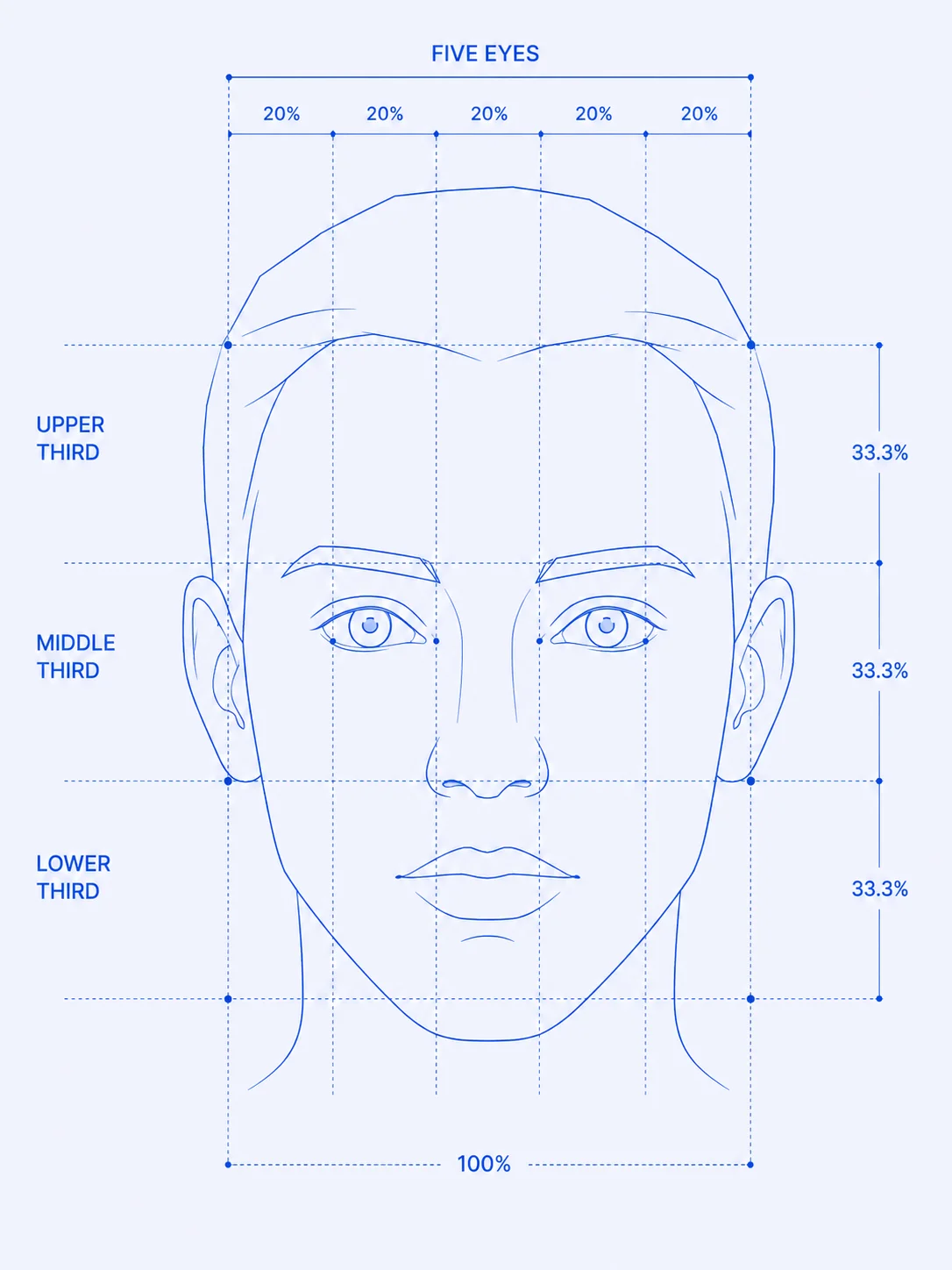
FacialHarmony facial-thirds and five-eyes proportion diagram

FacialHarmony’s official proportion diagram illustrates the type of frontal framework used to explain facial thirds and horizontal spacing. It is a reference framework, not a universal rule that every face should match exactly.

The distinction between having landmarks and having an interpretable report matters. Google’s official MediaPipe documentation states that its Face Landmarker can estimate 478 three-dimensional facial landmarks, but landmark count alone does not define the quality of a consumer analysis product. The product must still decide which distances to calculate, how to normalize them, which reference range to use, how to handle pose and occlusion, and how to communicate uncertainty.

That is why claims such as “95% accurate,” “pixel-level precision,” or “the exact face shape” should be read as vendor statements unless a public benchmark explains the dataset, ground truth, test protocol, demographic composition, error measure, and failure cases. FaceShapeLab’s own disclaimer appropriately says classifications may vary with image quality, lighting, camera angle, expression, and algorithm choice. FacialHarmony similarly states that its scores are algorithmic estimates and that different photographs of the same person can produce different results.

Facial proportions should also be interpreted as descriptive frameworks, not laws of beauty. Anthropometric research can examine relationships among facial dimensions, but results depend on the population, sample, measurement method, and attractiveness-rating procedure. A consumer report is therefore most useful when it says, “This relationship appears broader, narrower, more centered, or less centered in this photograph,” rather than claiming that a deviation proves unattractiveness or requires correction.

A responsible reading process is simple:

  1. Use an evenly lit, unfiltered, front-facing photo with a neutral expression and visible forehead and jaw.
  2. Check pose, confidence, and image-quality warnings before reading fine differences.
  3. Treat face-shape labels as vocabulary, especially when probabilities are mixed.
  4. Focus on stable patterns across comparable retakes, not decimal-level changes between unrelated selfies.
  5. Prefer reversible options—hair, eyewear, grooming, posture, lighting, and photography—over medical or invasive conclusions.
  6. Stop using the tool if repeated scoring is worsening mood or becoming a substitute for professional care.

Both official products support this restrained interpretation: FaceShapeLab calls its results estimates and general styling guidance, while FacialHarmony explicitly states that scores do not measure attractiveness, health, character, or personal worth and that its suggestions are limited to low-risk areas.

Bottom line: FaceShapeLab wins on speed, free access, styling orientation, mixed-shape presentation, and dashboard breadth. FacialHarmony wins on ratio depth, evidence, interpretability, confidence and pose gating, report structure, and a documented improvement path. The right choice depends less on which tool has “more AI” and more on whether the user wants a style answer or an explanation they can inspect and revisit.

Useful internal pages:

  • Start with the free Face Shape Test when the main question is contour classification.
  • Use the Facial Harmony Test when the goal is proportions, symmetry signals, thirds, and multi-category balance.
  • Inspect the Example Report before purchasing.
  • Check the latest Pricing before quoting a price or promising a feature.

FAQ

Is FacialHarmony more accurate than FaceShapeLab?

There is not enough public, independently benchmarked evidence to make a defensible universal accuracy claim. The products also optimize for different outputs. FaceShapeLab emphasizes fast classification and styling; FacialHarmony emphasizes multi-ratio interpretation, evidence, and confidence. A tool can classify shape well without producing the best proportion report, and a detailed proportion report does not automatically prove superior shape classification. Both remain dependent on the submitted photograph.

Does FaceShapeLab only detect face shape?

No. Its platform includes separate tools for symmetry, estimated age, eye shape, nose shape, lip shape, emotion and smile, and similar faces. Its symmetry page also describes facial-thirds, golden-ratio, alignment, and feature-spacing outputs. Its strongest overall positioning, however, remains fast feature detection combined with practical style recommendations.

Does FacialHarmony detect face shape?

Yes. Face shape appears as one of seven categories in the example full report, and FacialHarmony also offers a dedicated Face Shape Test. The difference is that the shape result can be viewed alongside facial thirds, eyes, brows, nose, mouth, jaw and chin, symmetry signals, confidence, and visual evidence.

Which is better for hairstyles, glasses, and beard suggestions?

FaceShapeLab is the clearer starting choice because hairstyle, eyewear, beard, makeup, accessory, and grooming recommendations are central to its product positioning. FacialHarmony also provides style and grooming tips, but they are presented as downstream actions connected to a larger analytical report.

Which is better for facial thirds and symmetry?

For a quick free symmetry and thirds check, FaceShapeLab’s dedicated symmetry tool is competitive. For a deeper explanation in which thirds and symmetry are interpreted beside approximately 30 ratios, category scores, confidence, pose status, and evidence overlays, FacialHarmony is the better fit.

Does FacialHarmony include a Coach?

The intended product journey may include Coach-style follow-up, but the public pages reviewed clearly specify a 30-day plan, report-linked priorities, and style and care tips—not a separately documented Coach entitlement. Before publishing a promise such as “Coach included,” verify the current interface, usage limits, and pricing.

Are the recommendations medical advice?

No. FaceShapeLab says its outputs are informational, educational, and styling-related rather than professional beauty, dermatological, cosmetic, or medical advice. FacialHarmony says its scores and suggestions are not diagnosis, treatment, psychological advice, cosmetic advice, or surgical recommendations.

Can I compare results from two different selfies?

Only cautiously. Use similar distance, lens, lighting, pose, expression, hair placement, and image quality. Otherwise, the comparison may primarily measure photography differences. FacialHarmony’s confidence and pose gates are especially helpful here, while FaceShapeLab also recommends a clear front-facing neutral photograph.

Which tool offers better value?

FaceShapeLab provides more free and low-cost utility if you expect to run repeated scans and mainly want styling outputs. FacialHarmony’s $9.99 one-time report is better aligned with someone who wants one deeper, reopenable analysis with ratios, evidence, explanations, and an improvement plan. Value therefore depends on frequency and depth, not simply the lowest displayed price.

Face analysisface-shapeFacial harmonytool-comparison

FacialHarmonyAI content is for informational and educational purposes only. It is not medical, psychological, or cosmetic advice.

Try the free analysis

Related articles

GuidesHow to Read Face Analysis Scores Without Overreading ThemA practical protocol for reading AI face analysis scores: check photo quality and confidence first, category notes next, overall score last—with research-backed reasons not to treat one number as destiny.July 28, 202612 min readGuidesWhen to Retake Your Photo for Face Analysis (and When It Won't Help)A practical decision guide for face analysis retakes: understand hard fails, soft warns, and confidence signals—know when a new photo improves measurement and when you are just chasing a number.July 28, 20268 min readGuidesFacial Harmony Done Right: How to Explore Your Proportions Without Falling Into the Social Media TrapThe TikTok trend got it wrong—but the science behind facial harmony is real. Here's how to understand your features with clarity, not comparison.July 20, 202611 min readGuidesFacial Harmony: The Science of Why Balanced Faces Captivate UsAn evidence-based exploration of how facial proportions shape perception—and how AI analysis can help you understand your own unique balance.July 20, 202610 min readGuidesFacial Harmony: Where Mathematical Precision Meets Psychological TransformationHow the science of proportion and the psychology of self-perception converge to create lasting confidence—and what it means for your own journey.July 20, 202611 min readGuidesThe Science of Personalized Facial Harmony: Why Your Face Is Uniquely BeautifulHow modern research is redefining beauty standards—and why understanding your individual proportions is the key to authentic confidence.July 20, 202611 min read