
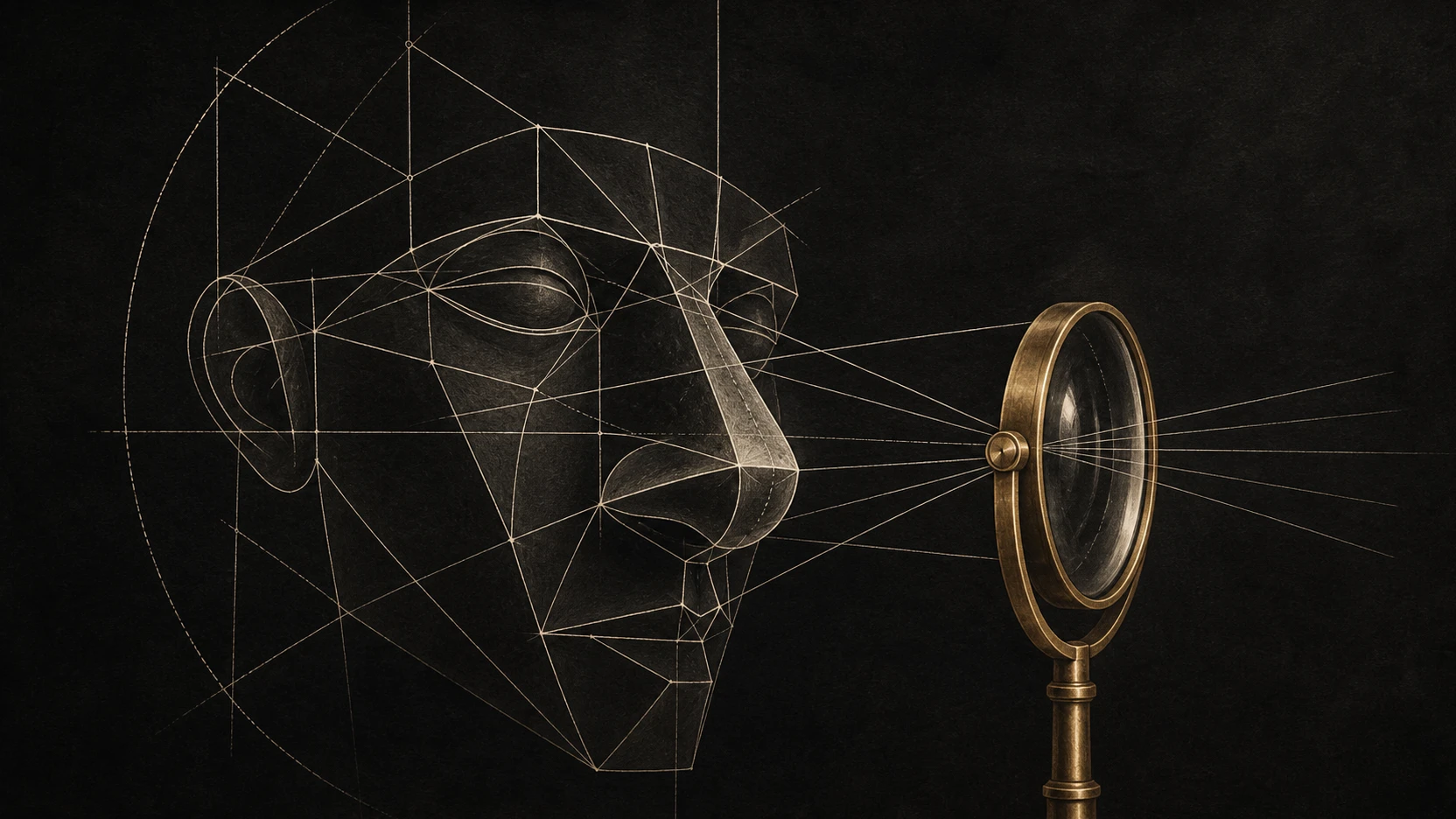
Have you ever taken a quick selfie with your front camera and felt like your nose looked wider or your face seemed awkwardly narrow compared to what you see in the mirror? Yet, when a friend takes a photo of you from six feet away using the rear camera, your facial contours look completely natural again.
This isn't your imagination, nor is your appearance fluctuating day to day. It is a well-documented optical phenomenon known as perspective distortion.
For computer vision algorithms that rely on facial feature detection (Face Landmarks), a close-up wide-angle selfie can be deceiving. The algorithm doesn't know how close the camera was to your face—it simply maps coordinates based on 2D pixel positions. As a result, geometric ratio calculations can skew significantly. In this guide, we break down how focal length and subject distance alter facial geometry based on optical physics, AI landmark mapping logic, and empirical data, while providing a practical setup to capture low-distortion reference photos using your smartphone.
Why Does Holding Your Phone Close Make You Look Completely Different From the Mirror?
Many people blame perspective distortion on "lens focal length," assuming a 24mm wide-angle lens inherently distorts faces. Strictly speaking, however, the sole physical factor determining perspective geometry is subject-to-camera distance.
When holding your phone out for a selfie, your arm extends roughly 30 to 40 cm (12 to 16 inches). To fit your entire face into the frame at such a short distance, smartphones automatically use a short focal length wide-angle lens (typically an equivalent of 24mm to 28mm).
Under standard perspective laws, objects closer to the lens occupy a larger proportion of pixels in the frame. In human facial geometry:
- The nasal tip and alar base are closest to the lens (~30 cm away);
- The zygomatic arches and ear roots sit further back (~40 cm away);
- The outer eye corners (canthi) and temporal regions reside on receding lateral planes.
At a 30 cm camera distance, that 10 cm depth differential represents a massive 33% difference in relative distance. Consequently, features nearest to the camera—like the nose—are disproportionately enlarged, while the sides of the face are compressed toward the edges of the frame.
According to a landmark study published in JAMA Facial Plastic Surgery (Ward et al., 2018), researchers built mathematical models calculating that at a 30 cm (approx. 12 inches) selfie distance, perspective effects inflate the perceived nose-to-face width ratio by roughly 30% in men and 29% in women. When the shooting distance increases to 1.5 meters (approx. 5 feet), this perspective distortion virtually vanishes.
24mm vs. 50mm / 85mm: How Perspective Stretch Distorts Key Facial Landmarks
To visualize how different focal lengths and distances alter geometric landmarks, let's compare three common photographic setups:
| Equivalent Focal Length | Typical Shooting Distance | Facial Geometric Changes | Impact on Ratio Measurements |
|---|---|---|---|
| 24mm – 28mm (Front-Camera Selfie) | ~35 cm (14 in) | Pronounced nasal tip, receded cheeks, narrower outer eye spacing | Nose-to-face width ratio heavily overestimated; central axis exaggerated |
| 50mm (Standard View) | ~1.5 m (5 ft) | Perspective matches natural human eye vision; proportional scaling | Vertical thirds and horizontal fifths reflect true anatomical state |
| 85mm – 105mm (Medium Telephoto Portrait) | ~2.0 m – 2.5 m (6.5–8 ft) | Subtle compression of facial depth; flattened outer contours | Ideal for fine measurement of forehead plane ratios and line curvature |
Modern computer vision frameworks—such as Google's open-source MediaPipe Face Landmarker—localize hundreds of 3D facial mesh points (3D Mesh Coordinates) on a 2D image plane.
When an input photo suffers from severe 24mm wide-angle distortion:
- Horizontal Ratio Miscalculations: The pixel distance from the outer eye corner (Exocanthion) to the lateral facial contour (Zygion) is compressed. The algorithm registers a smaller outer eye-to-edge width, incorrectly classifying the face as narrower or longer than it actually is.
- Vertical Midface Distortions: The projected distance from the nasal bridge root (Nasion) to the subnasal point (Subnasale) is affected by camera tilt and perspective scaling, causing calculated midface length values to deviate from anatomical reality.
For a comprehensive practical checklist on lighting, angles, and distances, check out our companion guide: /blog/photo-for-accurate-ai-face-analysis.
How Optical Distortion "Tricks" AI Landmark Algorithms
When uploading a photo for AI-assisted geometric analysis, what actually happens under the hood?
As highlighted in frameworks such as QOVES Insights' Facial Proportionality research, classic aesthetic research (such as Farkas anthropometry) relies on orthographic projection or standardized long-distance photography. Academic proportions evaluate geometric relationships between anatomical landmarks in true 3D space.
Standard 2D landmark detection algorithms, however, compute pixel-plane distances on flat images. When a photograph carries physical perspective warping:
- Landmark Coordinate Shift: The model locates the alar base points (Alare) at their exact visual pixels on the image, but those pixels have already been optically enlarged by the wide-angle lens.
- Compounding Ratio Errors: When computing key proportional metrics like Nasal Width / Intercanthal Distance or Zygomatic Width / Bigonial Width, the numerator is inflated while the denominator is compressed. The resulting ratio strays significantly from true physiological proportions.
This explains why re-uploading casual selfies taken at varying distances yields inconsistent geometric outputs—a topic we unpack in detail in /blog/why-ai-face-scores-change.
How to Take Low-Distortion Frontal Photos with Your Smartphone
Since the root issue stems from camera distance and focal length choice, how can you take measurement-ready reference photos with your phone—without requiring a DSLR or professional studio?
Here is a 4-step practical method:
Switch to 2x or 3x Rear Telephoto Lens: Most standard smartphone main cameras (1x) have an equivalent focal length of 24mm to 26mm. Switching to 2x or 3x telephoto modes (typically 48mm to 77mm equivalent) physically eliminates wide-angle distortion.
Maintain a 1.5-Meter (5-Foot) Physical Distance: Avoid holding the phone close to your face. Place your phone on a tripod or table, or ask a friend to take the shot. Ensure the lens sits at least 1.5 meters away from your face (roughly full arm's length extended twice).
Keep the Lens Level with Eye Height: High camera angles make the forehead appear disproportionately large and chin shorter; low angles elongate the chin and expose nostrils. Position the camera level with your eye line, ensuring your facial plane remains perpendicular to the lens axis.
Use Even Ambient Light & Neutral Gaze: Avoid harsh overhead or direct side lighting that creates shadows obscuring key landmarks. Gaze naturally straight ahead into the camera lens with a relaxed, neutral expression (avoid smiling or purse-lipped poses) so that the glabella, subnasale, and menton remain in their natural resting positions.
Summary: Master the Optics to Understand Your True Facial Structure
Exploring facial geometric proportions is about understanding your unique features objectively—not conforming to rigid templates or arbitrary ideal scores. The Golden Ratio ($\phi \approx 1.618$) referenced in classical aesthetics serves merely as an exploratory reference line; modern science confirms that facial harmony depends on cohesive multi-dimensional relationships rather than isolated numbers.
By eliminating physical optical errors from your reference photos, you gain a clear, accurate view of your forehead plane, midface length, and lower-third facial ratios.
If you are interested in exploring your facial geometry systematically, FacialHarmonyAI provides an accessible measurement and analysis experience:
- Browser-Side Local Processing: Landmark detection runs directly inside your device's web browser, so your private photos are never uploaded to external servers.
- Free Instant Preview: Instantly generates basic proportional structural outlines to help evaluate your photo's camera geometry quality.
- In-Depth Atelier Report: For a complete analysis breaking down ~30 ratio metrics across forehead planes, facial thirds, and horizontal symmetry, you can unlock our $9.99 one-time report (no recurring subscriptions or hidden charges).
By understanding the optics behind your photos and side-stepping front-camera selfie distortion, you can discover your true facial geometry with confidence.
References
- Ward, B., Ward, M., Fried, O., & Paskhover, B. (2018). Nasal Distortion in Short-Distance Photographs: The Selfie Effect. JAMA Facial Plastic Surgery, 20(4), 333-335. PMC5876805
- Google AI Edge. (2026). MediaPipe Face Landmarker Task Guide. Google Developers
- QOVES Insights. (2026). Facial Proportionality: An Evidence-Based Guide. QOVES Insights