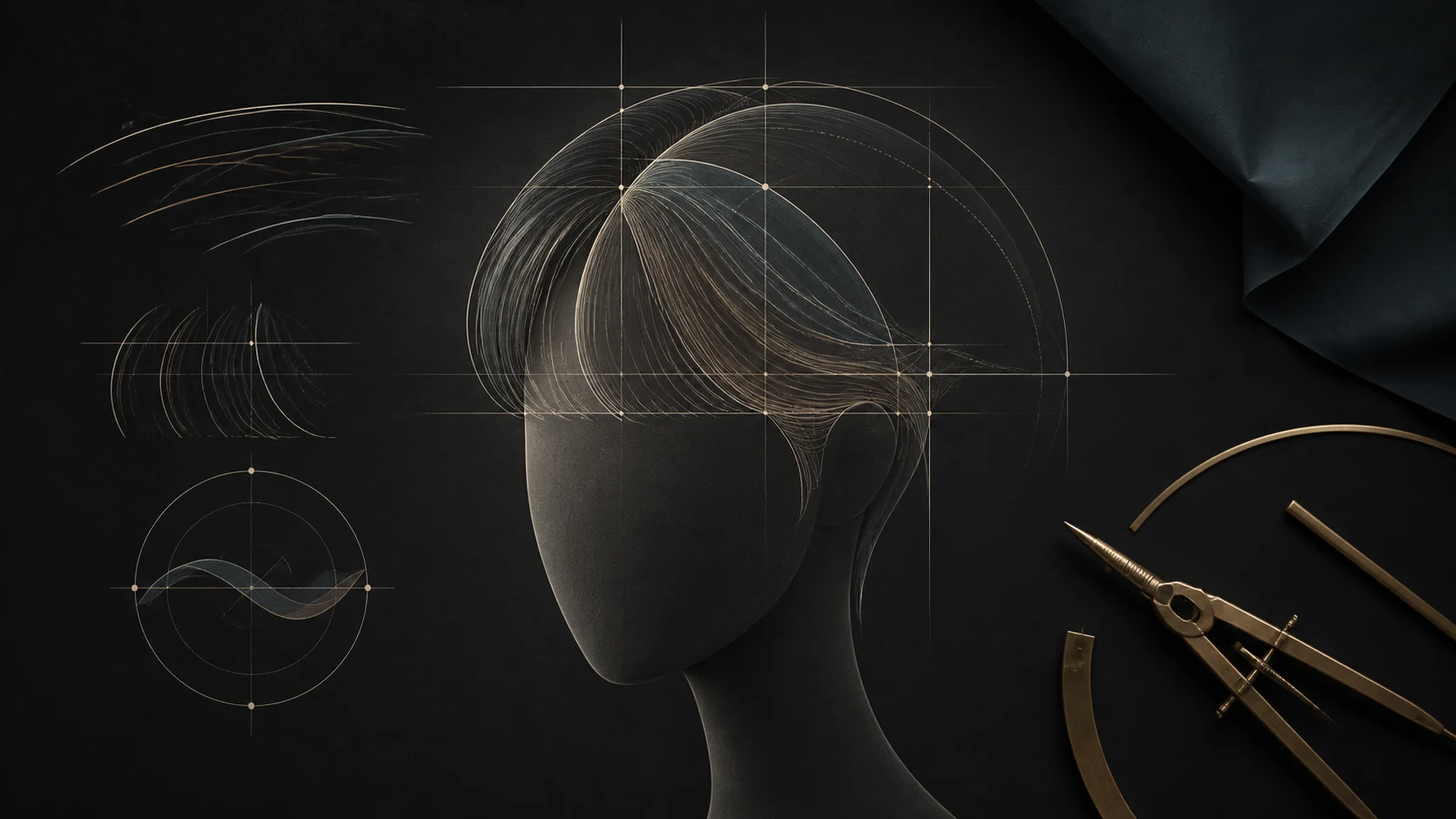
When discussing facial harmony, the hairline is often described as the "picture frame of the upper face." The height, width, and curvature of this frame directly shape how observers perceive your upper third and overall vertical facial proportions at first glance.
Many assume that rebalancing facial proportions requires cosmetic procedures or complex interventions. In reality, simply understanding the relative height proportion of your Trichion-to-Nasion (hairline to glabella) segment—paired with targeted hairstyle framing and strategic bangs—can deliver remarkably noticeable visual harmony without invasive measures.
1. Facial Thirds in Anthropometry: Ideal Ratios vs (see also [neoclassical canons validation](https://pmc.ncbi.nlm.nih.gov/articles/PMC4369102/)). Real-World Variation
In classical aesthetic composition, the concept of "Facial Thirds" serves as a benchmark for evaluating proportions:
- Upper Third: From the hairline landmark (Trichion) to the soft-tissue glabella/nasion (Nasion)
- Middle Third: From Nasion to the subnasal point (Subnasale)
- Lower Third: From Subnasale to the lowest point of the chin (Menton)
Academic studies have examined these proportions in depth. Milutinovic et al. (2014) in The Scientific World Journal evaluated facial traits across 83 non-celebrity women and 24 female celebrities, finding that the celebrity group demonstrated significantly higher regularity in facial third and fifth proportions, alongside refined facial outlines.
However, as landmark anthropometric surveys by Farkas and broader industry syntheses (such as QOVES analysis, Farkas-based anthropometry review) highlight, the vast majority of individuals do not possess perfectly equal 1:1:1 facial thirds. The "golden ratio" or equal-thirds rule is merely a reference framework for aesthetic composition—not a rigid or singular definition of beauty. A slightly longer or shorter upper third is completely normal; optically restructuring your upper-third framing through strategic hair styling can effortlessly bring cohesive harmony to your look.
2. Upper-Third Proportions & Hair Styling Visual Decision Tree
The core principle behind optical styling is straightforward: alter the observer's perceived starting point of the upper third and reshape the shadow boundaries of the forehead and scalp. Depending on your vertical upper-third proportion, refer to the decision tree below:
| Upper Third Trait |
Perceived Visual Effect |
Styling Goal |
Recommended Bangs & Hairstyles |
Hairstyles to Avoid |
| Relatively Long Upper Third (Trichion-to-Nasion distance significantly exceeds middle and lower thirds) |
High forehead exposure; visual center of gravity shifts downward |
Lower the perceived hairline origin; break up expansive forehead real estate |
French Bangs, Curtain Bangs, side-parted face-framing waves, soft low-part natural down-hair |
Sleek high ponytails, slicked-back pompadours without bangs, exposed-forehead shaved styles |
| Relatively Short Upper Third (Hairline sits lower; narrow forehead area) |
Upper face feels compressed; visual focus concentrates heavily on the middle third |
Extend vertical height of the upper third; visually elevate forehead and crown |
No-bangs open forehead styles, voluminous crown hairstyles, airy swept-side bangs, 7/3 side-parted waves |
Heavy blunt bangs, dense straight-across bangs covering the entire forehead |
| Balanced Upper Third (Proportions evenly distributed across all three thirds) |
Hairline frame naturally aligns with middle and lower thirds |
Preserve existing boundary balance; highlight lateral facial features |
Versatile across most hairstyles; select freely based on overall face shape contour |
Overly exaggerated or asymmetrical cuts that distort natural head proportion balance |
3. Fine-Tuning Techniques for Hairline Contours
Beyond vertical length, the structural shape of the hairline itself significantly influences how wide or narrow your upper face appears:
- M-Shaped Hairline / Receding Temples
Recessed temporal corners can make the forehead appear overly broad. Incorporate delicate wispy baby hairs or curtain bangs to seamlessly transition toward the cheeks, concealing lateral indentations.
- Square Hairline
Right-angle turns create a boxy forehead contour. Opt for soft curved wave bangs or side-swept bangs to soften rigid angular lines.
- Rounded or Low Hairline
Boost root volume to optically raise the crown (craniometric height) and diffuse severe parting lines, creating an airy, extended upper-third appearance.
4. How to Objectively Analyze Your Upper-Third Proportions
Rather than relying on mirror estimates, scientific measurement provides precise, objective facial proportion metrics.
You can read our guide on how to measure facial thirds to learn the mechanics of manual landmarking and geometric calculations. If you prefer to bypass tedious manual work:
- 100% Client-Side Privacy: With FacialHarmonyAI, simply upload a clear frontal photo. Landmark analysis executes locally inside your browser without uploading or storing your photos on server databases, ensuring complete privacy.
- Multidimensional Ratio Insights: The algorithm measures around 30 facial proportion parameters—including the Trichion-to-Nasion distance—focusing on structural facial harmony rather than assigning arbitrary shaming scores.
- Zero-Barrier Preview: Take a free online facial proportion test anytime for instant visual feedback. For deep comprehensive analytics, unlock the $9.99 Atelier Full Report whenever you choose—a one-time purchase with no recurring subscription.
Armed with objective data and clear proportion targets, you can communicate seamlessly with your hair stylist to craft a look uniquely tailored to your features.
Sources