
Looking for a FaceIQ Labs Alternative? Why Proportion Analysis Beats Black-Box Attractiveness Scores
You’ve likely come across this type of software on social media: you upload a selfie, and seconds later the app pops up a blunt rating—like "7.2/10" or "Average." If you have ever used FaceIQ Labs or similar AI face-rating apps, you’re probably familiar with that confusing feeling of psychological whiplash: not only is it completely unclear how the score was calculated, but you might also unwittingly find yourself locked into a recurring monthly subscription.
More importantly, assigning a score to someone's appearance using a black-box algorithm offers no meaningful insight—it serves only to fuel aesthetic anxiety.
If you are looking for a FaceIQ Labs alternative that respects your privacy, offers transparent pricing, and takes a genuine structural and proportional approach, it’s time to re-evaluate: what is the right way to approach facial analysis?
Why Are More People Leaving FaceIQ Labs?
Analyzing user feedback across facial analysis tools, people generally seek alternatives for three major reasons:
- The "Attractiveness Score" Black Box: Traditional rating software often outputs a single arbitrary number without indicating reference frames or displaying geometric coordinate points. This superficial judgment frequently induces unnecessary anxiety.
- Hidden Auto-Renewal Traps: Many similar products appear cheap initially, but hide expensive weekly or monthly recurring subscriptions that quietly charge your account.
- Photo Privacy Concerns: Uploading high-resolution front-facing photos to unknown remote servers for long-term storage raises serious user concerns regarding biometric data leaks.
In contrast, a healthier, more scientific analysis tool should focus on facial harmony rather than arbitrary "attractiveness judgments."
Core Feature Comparison: FaceIQ Labs vs. FacialHarmonyAI
To give you a clear, side-by-side view of the differences, we have highlighted the key dimensions below:
| Comparison Dimension | Traditional Rating Apps (e.g., FaceIQ Labs) | FacialHarmonyAI |
|---|---|---|
| Core Analysis Logic | Black-box algorithms, single Attractiveness Score | Geometric ratio analysis & facial harmony evaluation (Explainable Ratios & Harmony) |
| Metric Transparency | Obscure or nonexistent data with vague commentary | Measures ~30 proportion metrics across the frontal plane (e.g., facial thirds, intercanthal distance to facial width ratio) |
| Privacy Protection | Uploads images to remote servers for centralized processing | Client-side (in-browser) landmark feature analysis prioritized |
| Pricing Model | Commonly weekly/monthly recurring subscriptions | Free preview; full Atelier report for a $9.99 one-time purchase |
| Psychological Design | Appearance scoring, public leaderboards (triggers aesthetic anxiety) | Anti-shaming design philosophy; focuses on deconstructing individual facial structure |
| Intended Purpose | Entertainment scoring, social bragging | Personal facial proportion awareness, hairstyle & makeup geometric reference (non-medical / non-surgical planning) |
On the FacialHarmonyAI Homepage, you can experience rapid, localized feature point extraction right in your browser—completely free of personal rating or judgment.
Rejecting the "Single Golden Standard": How Science Views Facial Symmetry and Proportions
Many rating apps preach the "Golden Ratio (φ = 1.618)" or "absolute symmetry" as the ultimate aesthetic truth. However, contemporary anthropometry and psychological research demonstrate that this oversimplified logic fails in reality.
1. Minor Asymmetry Is a Completely Natural Phenomenon
Academic research (such as the symmetry perception study by Eißing et al., published in the Journal of Personalized Medicine, 2024) indicates:
- There is a strong negative correlation between perceived facial symmetry scores and objective asymmetry values (moderate-range correlation coefficient ρ ≈ -0.78, p < 0.001).
- However, perfectly symmetrical or digitally mirrored faces show no inherent superiority in perceived attractiveness compared to slightly asymmetrical faces.
- The study emphasizes that minor anatomical asymmetry is universal in human faces, and these subtle variations do not detract from overall visual comfort.
In other words, demanding mirror-like facial symmetry is unnecessary. Chasing "absolute symmetry" stems from a fundamental misunderstanding of human facial geometry.
2. Classical Artistic Canons vs. Anthropometrics (Farkas)
In their empirical guide on facial proportions (r08), QOVES compared classical Renaissance artistic canons with Farkas anthropometric data. Historically proposed proportions, such as the "Rule of Thirds" and "Rule of Fifths," represent idealized geometric hypotheses, whereas healthy, harmonious real-world faces exist within a reasonable range of variance.
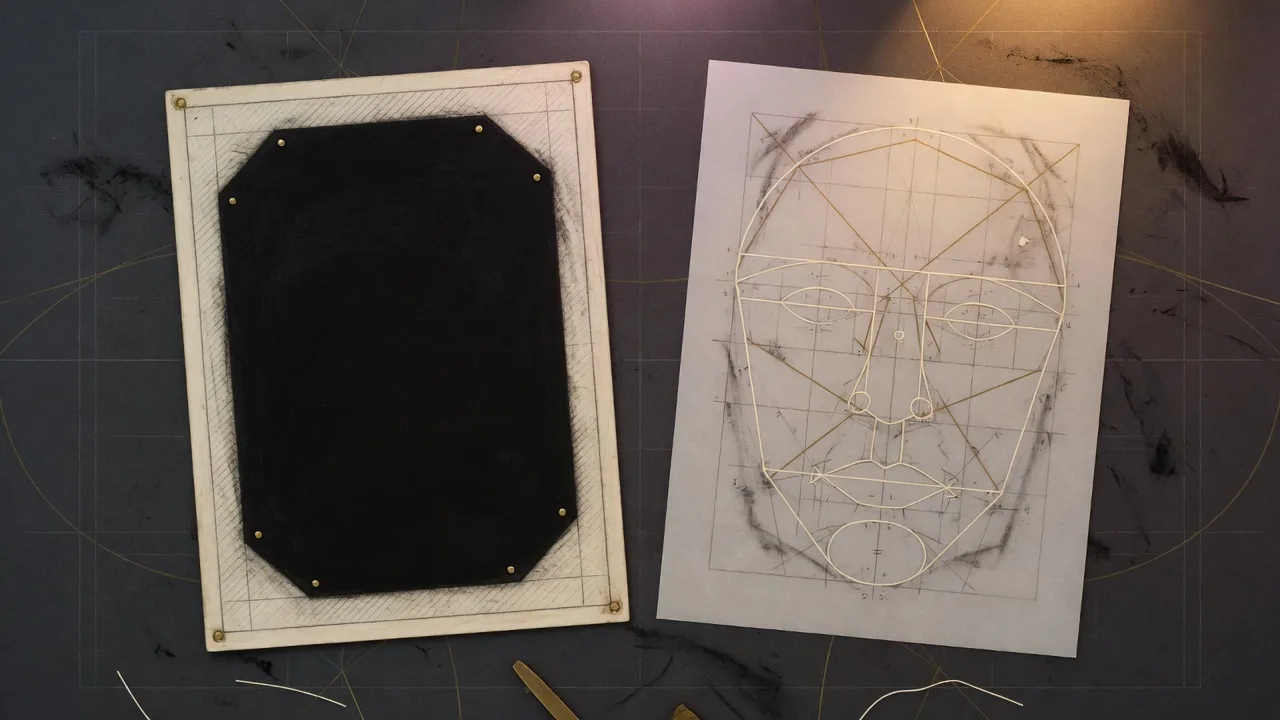
Therefore, FacialHarmonyAI does not set an arbitrary "perfect score." Instead, it clearly presents your facial structure distribution through approximately 30 relative proportion metrics across the frontal plane.
A More Rational Alternative Path
If you prefer detailed structural breakdowns over empty numerical scores, a more scientific analytical workflow should include:
- Structural Visualization: Clear visibility into upper, middle, and lower facial third distributions, helping you understand where your visual center of gravity rests.
- Harmonious Ratios Over Isolated Metrics: Understanding relative relationships—such as intercanthal distance relative to cheekbone width and facial height—provides far more utility than focusing on single isolated measurements.
- Explainable Data Reports: Grasping the measurement baselines and geometric significance of each metric, offering objective reference points for daily styling, eyewear selection, or makeup application.
If you have explored other analysis tools previously, check out our FacialHarmony vs FaceShapeLab In-Depth Review to learn more about how different analytical dimensions compare.
Conclusion: Take Ownership of Your Facial Geometry Data
Your facial proportions form your unique geometric signature—they do not need to be categorized or judged by a blunt score from an app.
The core of finding a FaceIQ Labs alternative is choosing an analysis tool that safeguards your data privacy, offers clear transparent pricing, and rejects appearance shaming. Through in-browser landmark extraction and an Atelier report available for a $9.99 one-time purchase, FacialHarmonyAI is dedicated to helping you rationally understand your facial harmony through transparent, explainable data.
Want to experience geometric proportion analysis designed without appearance shaming? Try a free Frontal Proportion Preview right now.