You just got a new haircut, or maybe picked up a new pair of dark-frame glasses. You catch yourself in the bathroom mirror and feel like something is slightly off, though you cannot quite put your finger on it. You pull out your phone, take a straight-on selfie, and zoom in. Your eyes, nose, and lips look completely fine on their own. Together, though, the visual balance feels pulled down, or your chin seems shorter than usual. That is usually when the question hits: is this just in my head, or are my facial proportions actually slightly out of balance?
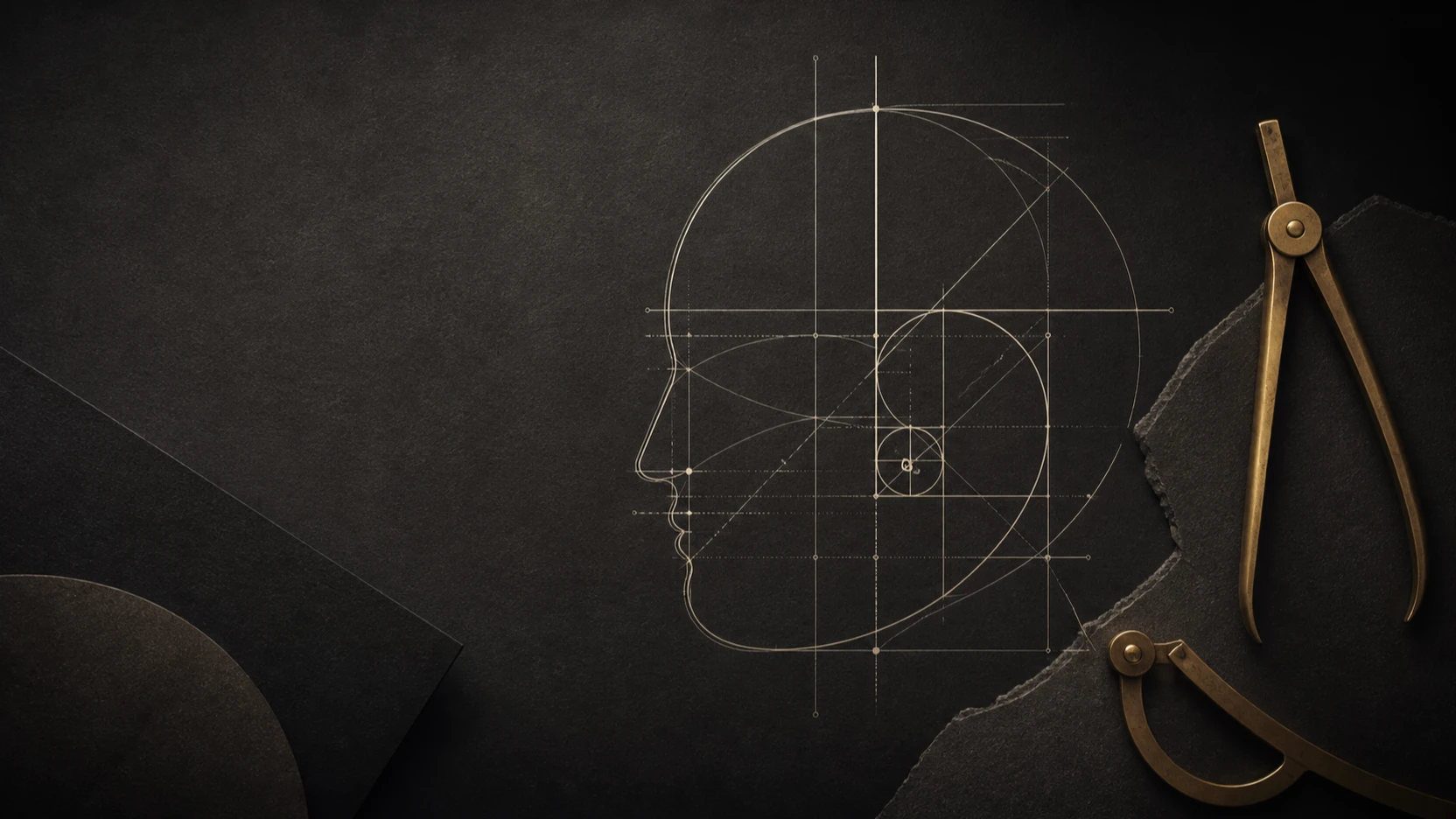
In that moment, a lot of people rush to test their faces against golden ratio masks online, or even post photos on public forums asking strangers to rate them. Cramming the richness of real human expression into cold geometric lines almost always produces pointless appearance anxiety. In aesthetic philosophy, objective geometry has never been the end goal of beauty. At best, it works like a tailor's ruler that helps you map out visual weight, not a verdict on whether your face is attractive.
Who is actually studying your facial proportions?
Almost nobody wakes up early in the morning and randomly decides to calculate the classic rule of fifths across their cheeks. People who look into this usually have very practical, everyday goals:
First, people who want to stop wasting money on bad styling decisions. Maybe you have had a couple of haircuts you hated, or bought frames that slipped down and pinched the bridge of your nose. Every time you sit in the salon chair, the stylist pitches whatever trend is popular, and you walk out feeling out of proportion. You realize that instead of guessing, it helps to understand the actual layout of your frontal facial plane.
Second, visual professionals framing a subject. When portrait photographers set up their angles and lighting, they never think about handing someone a numeric score. Instead, they look at brow-to-eye spacing, cheekbone width, and the jaw angle to decide whether side lighting flatters the bone structure or soft frontal diffusion works better.
Third, design and art enthusiasts exploring aesthetic theory. If you have spent time around art history or design, you have probably run into classic proportion rules and wondered whether centuries of theory hold up under modern cognitive science.
When you explore facial measurements on your own terms, the purpose should be clear: you are not looking for an algorithm to assign you a humiliating score. You just want an objective baseline to help you pick better hairstyles, choose flattering eyewear, or handle everyday grooming without second-guessing yourself.
What geometry can tell you before a haircut or after a weird selfie
Most styling confusion happens at two specific moments: right before making an image change, and right after a front-facing selfie looks completely different from what you see in the mirror.
At both points, objective geometric data acts like a visual translator.
Picture this: you are thinking about getting straight, blunt bangs. If your upper third (forehead) is already compact while your middle third (brow to nose base) is longer, thick bangs will cover your forehead completely. That forces all visual focus straight onto the nose and midface, making the midface look even longer and giving the expression a stern cast. If you know your vertical thirds ahead of time, you might choose light curtain bangs or a textured side part instead, leaving the center forehead visible to keep vertical balance flowing.
Geometry never tells you how your face must look. It simply shows how light, shadow, and hair create visual leverage across your features. For instance, Pallett et al., 2010 showed in their psychophysical research on facial proportions that visual processing runs smoothest when vertical eye-to-mouth distance sits around 36% of total facial height, and pupil-to-pupil width sits near 46% of facial width. That does not mean stepping away from those numbers looks bad; it simply describes how human visual processing handles spatial relationships.
The golden ratio: absolute truth or aesthetic myth? what research shows
In careless commercial marketing, the golden ratio (phi ≈ 1.618) is often treated like an untouchable aesthetic rule. Some creators even promote golden ratio masks, claiming any face that does not fit is somehow flawed.
Modern academic research tells a very different story. In a comprehensive review published by Londono et al., 2024 in The Journal of Prosthetic Dentistry, researchers examined extensive literature on natural facial aesthetics. The findings were clear: across diverse ethnic groups with naturally balanced faces, measured vertical proportions do not strictly follow the golden ratio, and the golden ratio shows no reliable link to real-world attractiveness.
Symmetry is another common point of confusion. Classic evolutionary psychology studies, such as Rhodes et al., 1998, showed that symmetry often correlates with visual appeal because human brains treat it as a biological health cue. Recent perceptual work, however, adds important nuance. A prospective study by Eißing et al., 2024 in the Journal of Personalized Medicine found that human vision has a generous tolerance threshold for mild facial asymmetry. Slight asymmetries are hard for the eye to catch, and perfect bilateral symmetry can actually look stiff and unnatural.
Philosopher Immanuel Kant pointed out long ago that aesthetic judgment is a subjective experience rooted in whole forms, not a mechanical sum of isolated measurements. Geometric data gives you an architectural floor plan, but character, expression, and vitality create the actual appeal.
A breakdown of subjective aesthetics versus objective geometry
To help you separate styling facts from aesthetic impressions, here is how objective measurements and personal taste divide their roles:
| Dimension |
Objective Geometric Analysis |
Subjective Aesthetic Experience |
Practical Styling Takeaway |
| Core definition |
Distances, angles, and ratios between anatomical landmarks |
Overall visual pleasure shaped by personal taste and context |
Use geometry to find physical baselines; use taste to pick your style |
| Typical metrics |
Vertical thirds, rule of fifths, eye-to-mouth height ratio |
Mood, warmth, presence, softness, or sharp structure |
Never let a single ratio dictate your overall personal vibe |
| Problems solved |
Parting lines, frame proportions, neckline depths |
Whether a look fits your personality, setting, and mood |
Use proportions to avoid visual clashing, then express yourself |
| View on mild asymmetry |
Records small differences in brow height or cheekbone width |
Treats minor asymmetry as natural character and vitality |
Normal, subtle asymmetry never needs aggressive correction |
| Tool boundaries |
Provides a neutral baseline across roughly 30 frontal ratios |
Leaves the final call on what looks good entirely to you |
Walk away from tools that turn measurements into rank-based scores |
Steer clear of public rating forums and appearance anxiety
One of the most counterproductive steps people take when curious about their features is posting a photo on anonymous forums with the caption: "Rate me on a scale of 1 to 10."
That is a fast track to appearance anxiety. Anonymous online ratings are filled with venting and group bias. One commenter having a rough day might give a harsh score because of bad lighting, while another gives an inflated number. Random opinions like that offer zero constructive guidance.
Even worse is the risk to your privacy and portrait rights. Once you upload a high-resolution frontal portrait to a public board or an unverified cloud tool, web scrapers can collect it, and it can easily end up in random facial training datasets.
Consider another common situation: a young professional wanting to understand their facial balance to pick sharp, workplace-appropriate glasses and a haircut. Posting on a public forum usually invites unhelpful nitpicking over tiny details instead of practical proportion advice, leaving them stuck in unnecessary self-doubt.
Healthy facial proportion analysis has to stay private, non-shaming, and non-ranking. A helpful tool shows how frontal planes interact with your styling choices instead of pinning an arbitrary grade on your face.
If you want modern technology to help you measure objective baselines, look for these key standards:
First, check whether processing runs locally in your browser or on a remote server. Modern tools built with privacy in mind use client-side edge computing, such as Google MediaPipe Face Landmarker. This means facial landmarks are extracted right inside your device memory to calculate roughly 30 frontal plane ratios. The raw photo never uploads to a server, keeping your biometrics secure from the start.
Second, see if it provides structural proportions or toxic scores. A solid aesthetic analysis focuses on objective facial harmony relationships, like vertical thirds distribution and the geometry between eye corners and nasal wings. If a platform pushes bold leaderboard rankings or uses anxiety to sell expensive fixes, close the tab.
Third, look for transparent pricing. Tools focused on privacy and balance, like FacialHarmonyAI, typically offer a free instant preview to show key frontal landmarks. If you want an in-depth Atelier breakdown of every regional relationship, it comes as a straightforward $9.99 one-time report with no hidden subscriptions or recurring traps.
Fourth, confirm the tool is strictly non-medical. Geometric tools are digital aesthetic rulers. They never replace clinical diagnosis from a maxillofacial surgeon or dermatologist; their only purpose is to guide everyday styling decisions.
Practical styling moves after finding your proportion baseline
Once you know your geometric layout through objective measurement, the smartest step is using low-cost, reversible styling adjustments to balance visual weight:
- Hair parts and contour framing:
If measurements show a slight difference in visual weight across your jawline, try a side part like a 60/40 or 70/30 split. The natural asymmetry of the hair softens the strict central axis and directs focus toward your favorite side.
- Frame depth and bridge placement:
If you have a longer midface, picking glasses with deeper vertical lenses and a lower bridge creates a subtle horizontal break that visually balances the length. If your midface is compact, lightweight frames with a higher bridge keep the area open.
- Neckline balance:
If your lower third is on the shorter side, open V-necks or scoop necklines draw the eye downward, creating clean visual length. If your lower third is longer with a defined jawline, boat necks or structured collars provide solid grounding.
Aesthetic exploration is never about forcing everyone into a single geometric mold. It is about understanding your own bone structure so you can find an effortless balance between objective geometry and personal taste.
References
- Londono J, Ghasmi S, Lawand G, et al. Assessment of the golden proportion in natural facial esthetics: A systematic review. The Journal of Prosthetic Dentistry, 2024.
- Eißing A, et al. Limits in the Perception of Facial Symmetry, A Prospective Study. Journal of Personalized Medicine, 2024.
- Rhodes G, Proffitt F, Grady JM, Sumich A. Facial symmetry and the perception of beauty. Psychonomic Bulletin & Review, 1998.
- Pallett PM, Link S, Lee K. New "Golden" Ratios for Facial Beauty. Vision Research, 2010.
- Google AI Edge. MediaPipe Face Landmarker guide.